AI tools for data analysis now spans fundamentally different categories: conversational data agents that answer questions and trigger actions, BI copilots that assist within traditional dashboards, predictive platforms that forecast outcomes, and lightweight personal tools for ad-hoc exploration. Evaluating them on a single list without classification leads to misaligned expectations and failed selections.
This guide organizes 10 leading tools into four functional categories, compares them across dimensions that matter for enterprise adoption, and provides a decision framework for choosing the right tool based on your actual data maturity and workflow requirements.
AI Tool Categories at a Glance
| Tool Type | Best For | Examples |
|---|---|---|
| Enterprise Data Agent | Natural-language analysis and action workflows | Dora |
| BI Copilot | Dashboard-based insights | Power BI Copilot, Tableau AI |
| ML/AI Platform | Model building and deployment | Vertex AI, DataRobot |
| Self-service Analytics | Governed business analysis | FineBI |
| Lightweight AI Analyst | Quick CSV/spreadsheet analysis | Julius, AnswerRocket |
Key distinction: Enterprise data agents like Dora operate on governed, trusted data foundations and close the loop from insight to action. BI copilots enhance existing dashboard workflows. Predictive platforms build models. Lightweight tools serve personal exploration. Choose based on whether you need an autonomous agent, a BI assistant, a modeling platform, or a personal explorer.
For deeper comparison of real-time capable tools, see our Best AI Analytics Tools for Real-Time Data guide. For foundational concepts, see What Is a Data Agent? and How to Build AI Agents for Data Analysis.
Top 10 AI Tools for Data Analysis in 2026
1. Dora by FanRuan: Best Enterprise Data Agent for Trusted Data Analysis
 Website: https://www.fanruan.com/en/dora
Dora is an enterprise AI Data Agent designed to help business users turn trusted data, dashboards, reports, and knowledge assets into actionable insights and decisions. Unlike BI copilots that assist within dashboards, Dora operates as an autonomous agent layer that retrieves data, generates explanations, pushes proactive insights, and triggers workflows — all grounded in governed enterprise data.
Core capabilities:
- Natural-language data Q&A: Users ask "Why did APAC revenue drop last month?" and receive sourced answers grounded in governed metrics, not generic LLM knowledge. Unlike generic chatbots, Dora resolves ambiguous terms against your semantic layer (e.g., "revenue" maps to your specific GAAP-compliant revenue definition, not a web-scraped estimate).
- Data retrieval across governed sources: Dora connects to FineBI semantic models, FineReport assets, warehouses, and knowledge libraries — retrieving only authorized data per user permissions. A regional manager asking about "Q2 margins" sees only their region's data; a CFO sees consolidated figures. Permission enforcement happens at query time, not after results are returned.
- Visualization and reporting assistance: Generates charts, tables, and narrative summaries from natural-language requests, reducing time from question to shareable output. Dora selects appropriate visualization types based on data characteristics and question intent — time-series for trend questions, bar charts for comparisons, tables for detail lookups.
- Alerting, reminders, and insight push: Configured thresholds trigger proactive notifications when metrics breach boundaries; scheduled briefings deliver daily/weekly summaries without user-initiated queries. Example: "APAC gross margin fell below 35% threshold on July 8; primary driver was freight cost increase (+12% MoM). Recommended action: review carrier contracts."
- Reusable data Skills and workflows: Frequently asked analyses become codified Skills — standardized, governed, reusable workflows that ensure consistent answers across the organization. A "Weekly Sales Variance Analysis" Skill encodes the exact calculation logic, data sources, and narrative template, eliminating analyst-to-analyst variation.
- Turning insights into business action: Closes the loop from analysis to execution by integrating with task systems, approval workflows, and notification channels. When Dora identifies a churn-risk account, it can create a CRM task assigned to the account owner with pre-populated context — transforming passive insight into tracked action.
FineBI provides governed metrics, semantic models, and visual analytics as the trusted foundation that Dora operates on. FineDataLink ensures the underlying data is trusted, timely, and synchronized across sources. Together, they form the governed data and analytics layer that makes Dora's AI interactions reliable and actionable.
When Dora delivers the most value: Teams that already have BI dashboards but still spend hours manually interpreting them, answering repetitive stakeholder questions, or translating dashboard findings into action items. Dora eliminates this interpretation gap without replacing the dashboards themselves.
2. Google Vertex AI: Best Predictive Analytics for GCP-Native Teams
 Website: https://cloud.google.com/products/vertex-ai-platform
Vertex AI is Google Cloud's unified ML platform for building, deploying, and managing predictive models. It serves data scientists and ML engineers, not business users seeking conversational insights.
| Strengths | Considerations |
|---|---|
| Full MLOps lifecycle on GCP infrastructure | Not a BI or conversational analytics tool |
| AutoML + custom model training flexibility | Requires ML expertise to extract value |
| Tight BigQuery and Looker integration | GCP ecosystem dependency |
| Real-time prediction endpoints for operational use | Cost scales with model count and compute |
Best for: GCP-native teams building production ML models for forecasting, classification, or anomaly detection.
3. Microsoft Power BI Copilot: Best BI Copilot for Microsoft Ecosystem
 Website: https://www.microsoft.com/en-us/power-platform/products/power-bi
Power BI Copilot integrates AI assistance directly into the Power BI authoring and consumption experience. It helps users create DAX measures, generate report narratives, summarize dashboard findings, and ask natural-language questions within the Power BI interface.
| Strengths | Considerations |
|---|---|
| Deepest Microsoft/Azure/Fabric integration | AI features require Premium/Fabric capacity licensing |
| Copilot assists DAX, report creation, summarization | Cross-cloud portability limited |
| Large community and third-party visual marketplace | Performance tuning required for large datasets |
| NL Q&A within existing Power BI reports | Not an autonomous agent; requires dashboard context |
Best for: Microsoft-centric enterprises wanting AI assistance within existing Power BI investments.
4. Tableau AI (Pulse + Agent): Best BI Copilot for Advanced Visualization
 Website: https://www.tableau.com/products/tableau-pulse
Tableau AI combines Pulse (automated metric digests) with Tableau Agent (conversational exploration in beta). It serves organizations where visualization depth and established Tableau ecosystem investment are primary differentiators.
| Strengths | Considerations |
|---|---|
| Most flexible visualization engine in market | Steeper learning curve for complex dashboards |
| Pulse delivers automated metric digests proactively | Agent features still maturing vs. dedicated data agents |
| Strong enterprise governance and embedding | Licensing cost scales with user count |
| NL exploration within Tableau Cloud/Server | Not a standalone agent; depends on Tableau semantic layer |
Best for: Tableau-invested organizations wanting AI-enhanced metric monitoring and conversational exploration within existing viz workflows.
5. IBM Cognos Analytics: Best AI-Enhanced BI for Legacy IBM Enterprises
 Website: https://www.ibm.com/products/cognos-analytics
Cognos Analytics adds AI-assisted exploration, natural-language querying, and automated pattern detection to IBM's established BI platform. Best suited for organizations already invested in IBM data infrastructure.
| Strengths | Considerations |
|---|---|
| AI-assisted data preparation and exploration | Declining market share; smaller talent pool |
| Natural-language querying over governed data | Modernization path less clear for cloud-native apps |
| Strong compliance features for regulated industries | Ecosystem less vibrant than competing platforms |
| Integrated planning and forecasting modules | Higher total cost vs open-source/cloud alternatives |
Best for: Legacy IBM enterprises in regulated industries requiring AI-enhanced BI within existing IBM investments.
6. DataRobot: Best AutoML Platform for Enterprise Predictive Analytics
 Website: https://www.datarobot.com/
DataRobot automates model selection, training, validation, and deployment for predictive use cases. It serves data scientists and ML engineers building production models, not business users seeking dashboards or conversational insights.
| Strengths | Considerations |
|---|---|
| End-to-end AutoML with model governance | Not a BI or conversational analytics tool |
| Real-time scoring APIs for operational integration | Requires ML expertise to extract full value |
| MLOps for monitoring and retraining | Cost scales with model count and compute |
| Time-series and causal modeling capabilities | Narrower ecosystem than cloud-native platforms |
Best for: Teams building production predictive models for forecasting, churn prediction, demand planning, or risk scoring.
7. Domo: Best Cloud-Native BI Platform with AI Insights
 Website: https://www.domo.com/
Domo is a cloud-native BI and data platform with built-in AI assistants for automated insights, trend predictions, and what-if analysis. It combines data integration, visualization, and collaboration in a single managed service.
| Strengths | Considerations |
|---|---|
| All-in-one platform: integration + BI + AI in one service | Higher per-user cost than modular alternatives |
| AI assistant for automated insights and forecasting | Smaller third-party ecosystem than Power BI/Tableau |
| Strong mobile-first design and collaboration features | Cloud-only; no on-premise deployment option |
| Pre-built connectors for 1,000+ data sources | Custom advanced analytics less flexible than dedicated ML platforms |
Best for: Mid-market to enterprise teams wanting an all-in-one cloud BI platform with integrated AI insights and minimal infrastructure management.
8. Qlik Sense with AI: Best Associative Analytics with AI Augmentation
 Website: https://www.qlik.com/us/use-cases/ai-analytics-platform
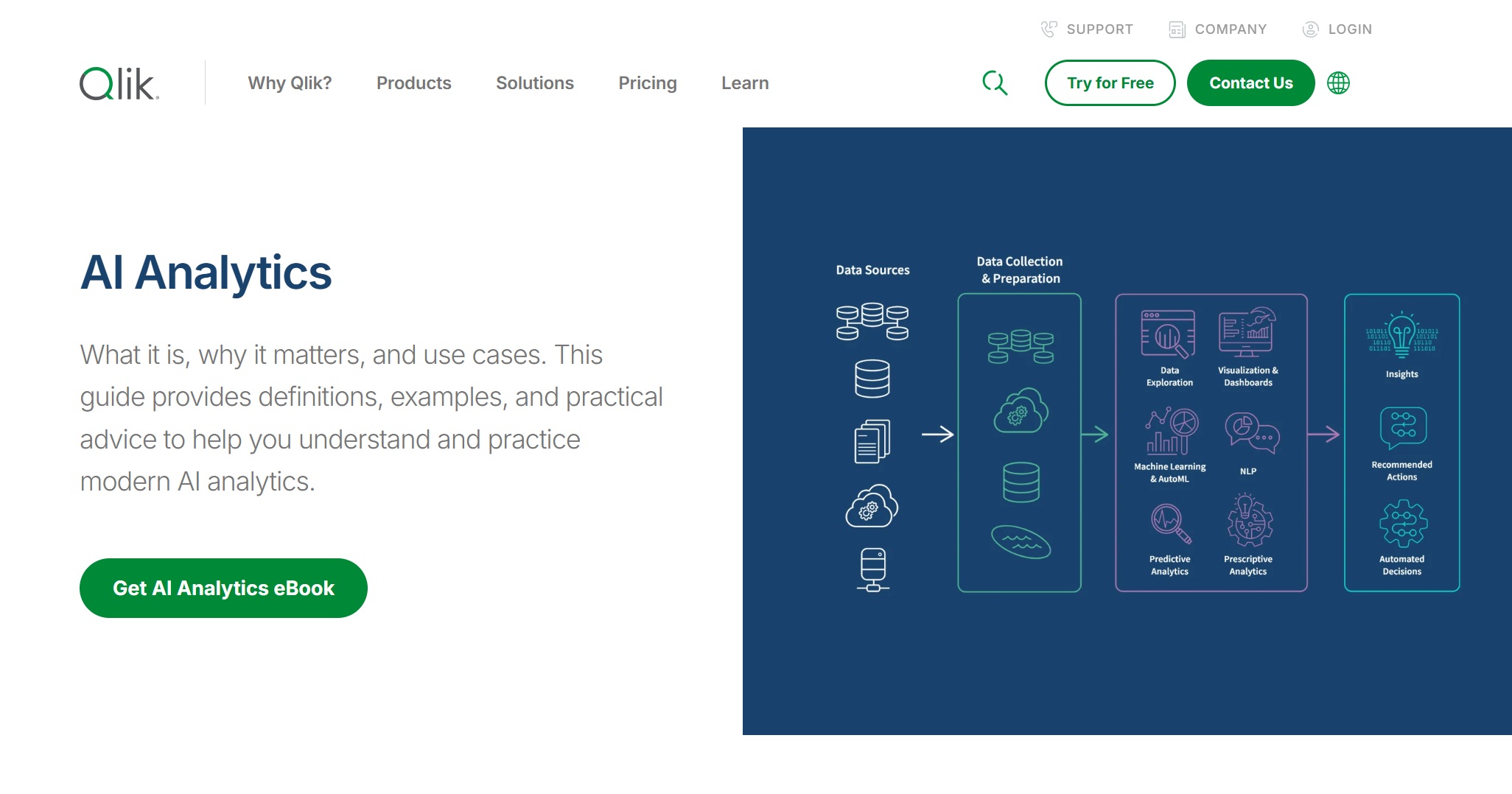
Qlik Sense combines its associative engine (exploring data freely without predefined queries) with AI-powered insights, natural-language interaction, and automated anomaly detection.
| Strengths | Considerations |
|---|---|
| Associative engine enables free exploration without pre-defined paths | Smaller community than Power BI/Tableau |
| AI-powered insight generation and NL interaction | Cloud migration still maturing vs competitors |
| Strong data integration via Qlik Data Integration | Learning curve for associative model thinking |
| Embedded analytics and OEM capabilities | Pricing complexity for large deployments |
Best for: Organizations valuing associative exploration and embedded analytics with AI augmentation.
9. Julius: Best Lightweight Personal AI Analytics
 Website: https://julius.ai/
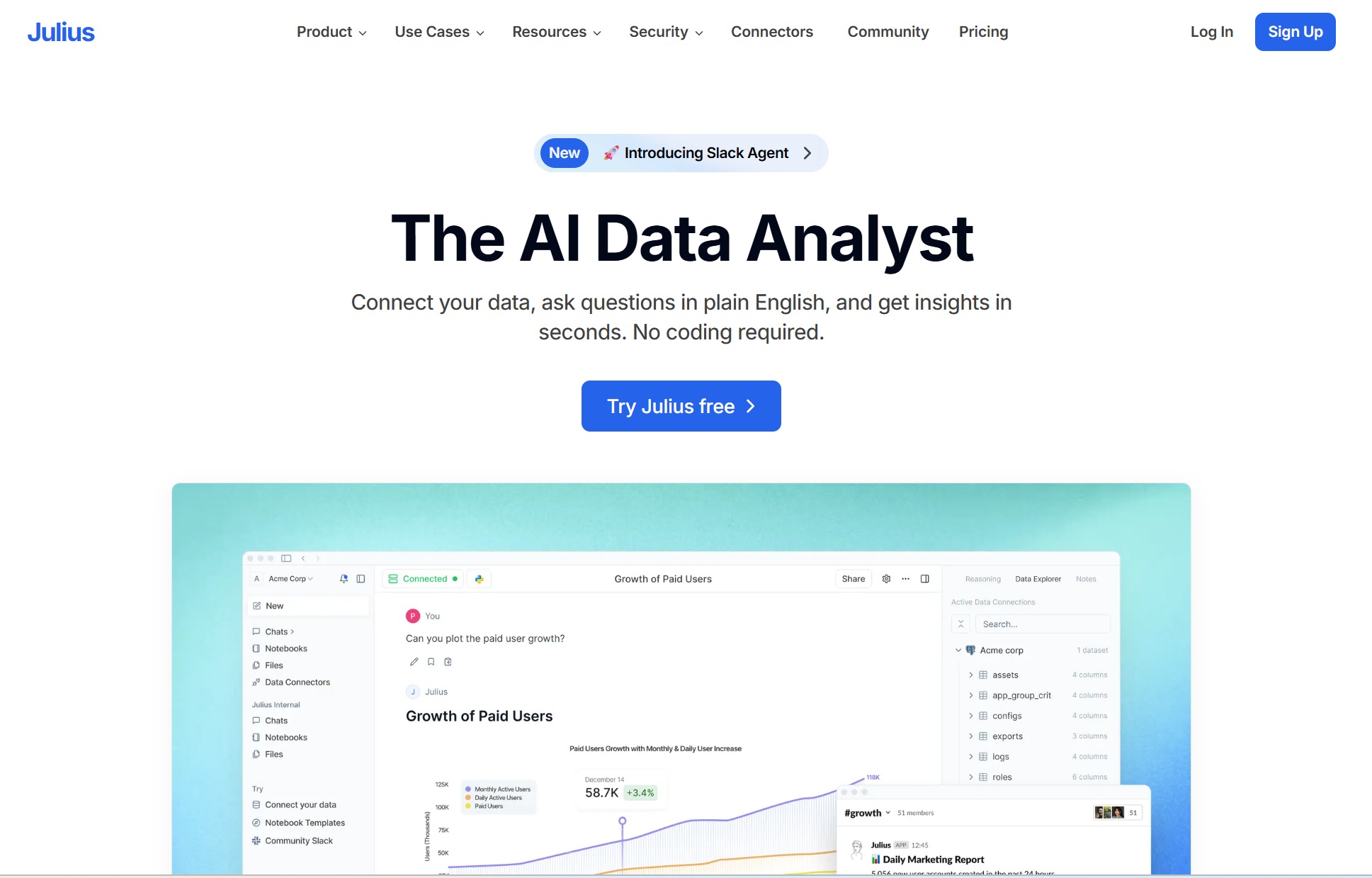
Julius is a consumer-grade AI analytics tool for quick, ad-hoc data exploration. Upload a CSV, ask questions in natural language, get instant charts. Zero setup, zero governance, zero enterprise features.
| Strengths | Considerations |
|---|---|
| Instant setup; upload spreadsheet and ask questions | No governance, permissions, or data source connectivity |
| Fast for personal exploration and prototyping | Not suitable for production enterprise analytics |
| Low/no cost for basic use | Data leaves local environment; compliance risk |
| Supports Python code generation for advanced users | No team sharing or scheduled delivery |
Best for: Individual users needing quick ad-hoc exploration of CSV/Excel files outside enterprise systems.
10. AnswerRocket: Best NL Analytics for Business User Self-Service
 Website: https://answerrocket.com/
AnswerRocket provides natural-language analytics over connected enterprise data sources, targeting business users who need answers without SQL or dashboard navigation. Positioned between lightweight personal tools and full enterprise data agents.
| Strengths | Considerations |
|---|---|
| NL Q&A over connected enterprise data sources | Smaller ecosystem than major BI platforms |
| Automated narrative generation from query results | Less mature workflow/action integration vs Dora |
| Pre-built connectors for common business systems | Governance model less comprehensive than enterprise agents |
| Focused on business user accessibility | Limited predictive/modeling capabilities |
Best for: Business users needing NL access to enterprise data without full autonomous agent capabilities.
AI Tools for Data Analysis Comparison Table
| Tool | Category | NL Q&A | Governed Metrics / Semantic Layer | Dashboard Generation | Predictive Analytics | Workflow / Action Integration | Enterprise Security | Best User Type |
|---|---|---|---|---|---|---|---|---|
| Dora | Enterprise Data Agent | Yes | Yes (via FineBI) | Assisted | Via connected platforms | Yes (native) | Yes (RBAC + tenant isolation) | Business users, managers |
| Vertex AI | Predictive / AutoML | No | No | No | Yes (core) | Via API | Yes (GCP IAM) | Data scientists, ML engineers |
| Power BI Copilot | BI Copilot | Yes | Yes (Power BI semantic) | Yes | Built-in | Limited | Yes (Azure AD + RLS) | Microsoft BI users |
| Tableau AI | BI Copilot | Yes (Agent beta) | Yes (Tableau semantic) | Yes | Built-in | Limited | Yes (Tableau Server/Cloud) | Tableau viz specialists |
| Cognos Analytics | BI + AI | Yes | Yes (Cognos semantic) | Yes | Built-in | Limited | Yes (IBM security) | IBM enterprise users |
| DataRobot | Predictive / AutoML | No | No | No | Yes (core) | Via scoring API | Yes (model governance) | Data scientists, ML engineers |
| Domo | Cloud BI + AI | Yes | Yes (Domo semantic) | Yes | Built-in | Limited | Yes (SOC2 + RBAC) | Mid-market to enterprise BI users |
| Qlik Sense | Associative BI + AI | Yes | Yes (associative model) | Yes | Built-in | Limited | Yes (Qlik security) | Exploratory analysts |
| Julius | Lightweight Personal | Yes | No | Basic | No | No | None | Individual users |
| AnswerRocket | NL Analytics | Yes | Partial | Basic | No | Limited | Moderate | Business users |
How to Choose an AI Tool for Data Analysis
Use this decision framework to match tools to your actual requirements:
- Is your data already trusted and governed? If not, invest in data integration and semantic layer first. AI tools operating on ungoverned data produce confident but incorrect outputs. FineDataLink establishes the trusted foundation; FineBI provides governed metrics; Dora consumes both.
- Do business users need natural-language Q&A? If yes, evaluate enterprise data agents (Dora) or NL analytics platforms (AnswerRocket). BI copilots (Power BI, Tableau) offer NL within dashboard context but are not autonomous agents.
- Do you need dashboards or autonomous agents? Dashboards serve visual exploration and monitoring. Agents serve conversational Q&A, proactive insight push, and workflow triggering. Many organizations need both: FineBI for dashboards, Dora for agent interactions.
- Do insights need to trigger workflows? If analysis must lead to action (task creation, approval routing, alert escalation), choose tools with native workflow integration. Dora closes this loop; most BI copilots do not.
- Do you need enterprise permissions and auditability? Regulated industries and multi-tenant environments require RBAC, row-level security, audit logging, and lineage. Enterprise data agents and governed BI platforms provide this; lightweight personal tools do not.
- Are you building predictive models or consuming predictions? Model building requires AutoML/predictive platforms (DataRobot, Vertex AI). Consuming predictions within business workflows requires BI platforms or data agents that integrate model outputs.
For additional evaluation criteria specific to real-time analytics, see our Best AI Analytics Tools for Real-Time Data comparison. For broader AI data analytics tool coverage, see Best AI Data Analytics Tools for Business.
Frequently asked questions
There is no single best tool. The right choice depends on your use case: Dora for enterprise data agents with governed NL Q&A and workflow integration; Power BI Copilot or Tableau AI for BI copilot assistance within existing platforms; DataRobot or Vertex AI for predictive model building; Julius for personal ad-hoc exploration. Match the tool category to your actual requirement.