
In process improvement, six sigma and lean production are often mentioned together, but they are not the same thing. Both aim to help organizations perform better, reduce inefficiency, and create more value for customers. However, they approach these goals from different angles.
If your team is deciding between these two methodologies, understanding their differences can save time, budget, and effort. In many cases, choosing the right approach can determine whether your improvement project delivers measurable results or becomes another initiative that fades away.
Six Sigma and Lean Production at a Glance
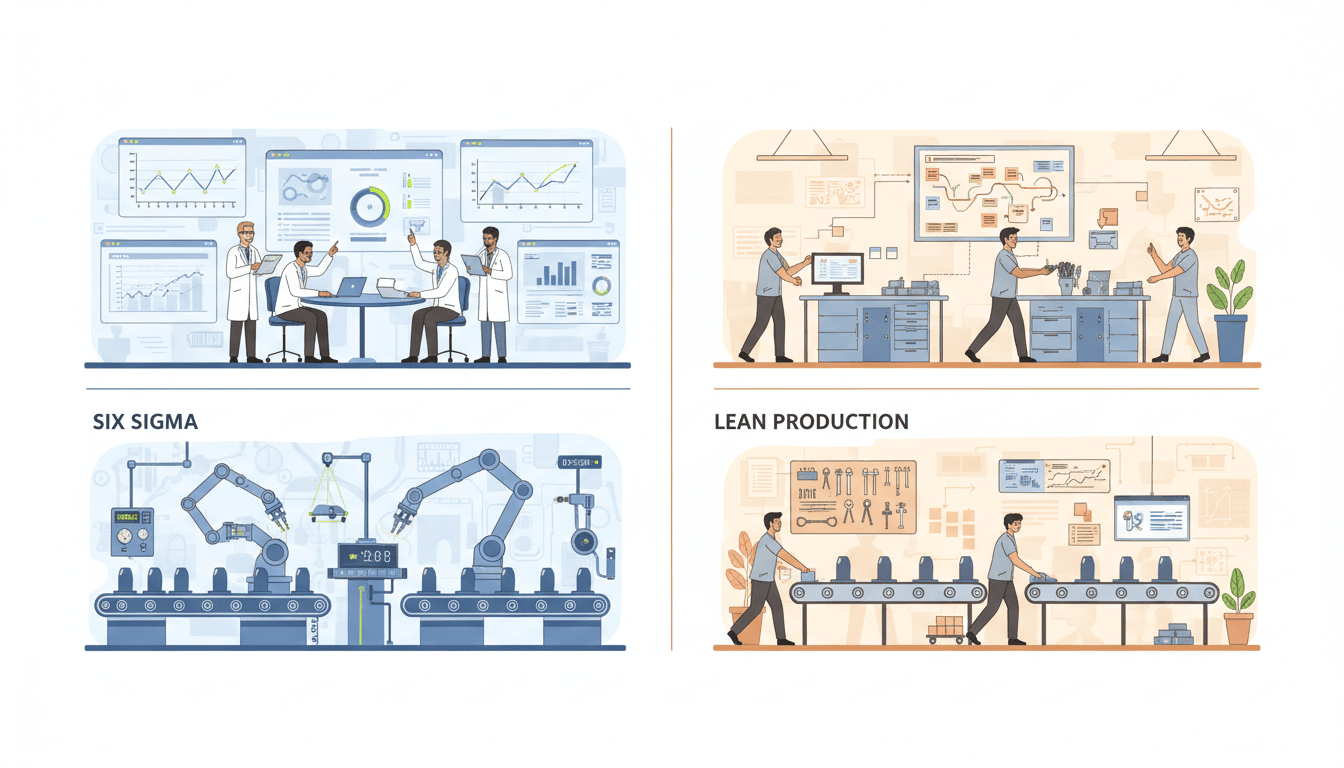
Six Sigma is a structured, data-driven methodology designed to reduce process variation and defects. Its main purpose is to improve quality and consistency by identifying root causes of problems and controlling them over time.
Lean production is a methodology focused on eliminating waste in processes. Its goal is to improve flow, speed, and efficiency by removing activities that do not add value for the customer.
In simple terms:
- Six Sigma asks: how can we make the process more consistent and accurate?
- Lean production asks: how can we make the process faster, smoother, and less wasteful?
This comparison matters because teams often face different kinds of operational problems. Some organizations struggle with defect rates, rework, or compliance failures. Others deal with delays, bottlenecks, excess inventory, and unnecessary process steps. Choosing the right strategy depends on the type of issue you need to solve first.
Key Differences Between Six Sigma and Lean Production
Primary focus
The biggest difference between six sigma and lean production is their primary focus.
Six Sigma concentrates on:
- Reducing variation
- Lowering defect rates
- Improving quality consistency
- Solving complex process problems with statistical analysis
This makes Six Sigma highly effective in environments where precision matters. If a product, service, or process must meet strict standards every time, Six Sigma provides the discipline to measure and improve performance.
Lean production concentrates on:
- Eliminating waste
- Improving speed
- Smoothing workflow
- Increasing customer value through better process flow
Lean is especially useful when work is delayed by unnecessary movement, waiting, overproduction, redundant approvals, or poor handoffs between teams.
A simple way to think about it:
- Six Sigma improves accuracy
- Lean production improves efficiency
Tools and methods
Six Sigma and Lean production use different tools, though some can overlap.
Common Six Sigma tools include:
- DMAIC (Define, Measure, Analyze, Improve, Control)
- Statistical process control
- Root cause analysis
- Hypothesis testing
- Control charts
- Process capability analysis
- Failure mode and effects analysis
DMAIC is one of the most recognized Six Sigma frameworks. It provides a step-by-step method to define the problem, measure current performance, analyze causes, improve the process, and maintain the gains.
Common Lean production tools include:
- Value stream mapping
- 5S
- Kaizen
- Kanban
- Standard work
- Visual management
- Continuous flow analysis
Value stream mapping helps teams see where time, materials, and effort are being wasted. The 5S method improves workplace organization and discipline. Lean tools are often more visible in day-to-day operations because they focus on process flow, workspace layout, and practical improvements.
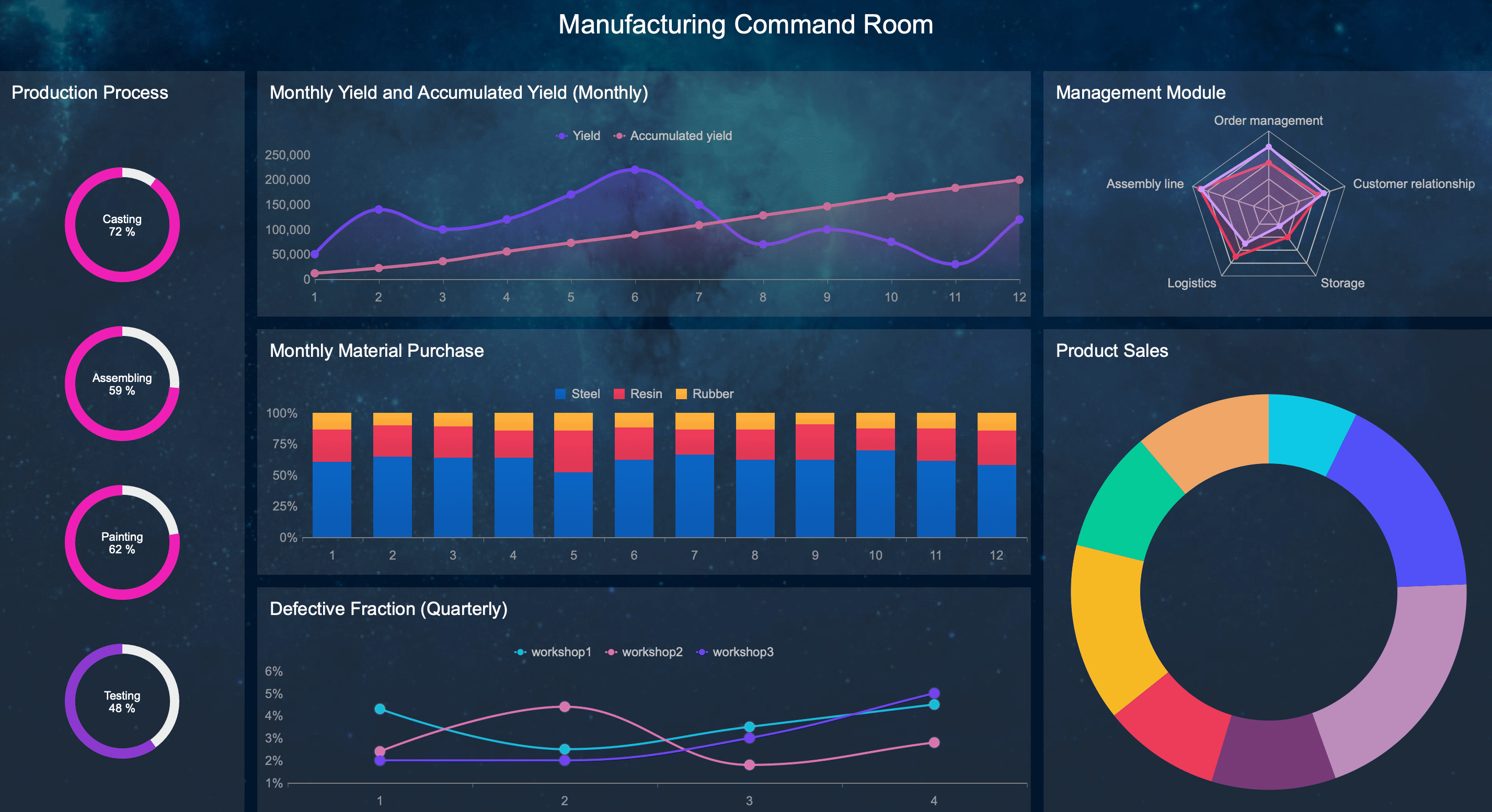
When discussing lean management tools, one critical success factor is data visibility. Many teams can identify waste conceptually, but struggle to monitor improvements continuously across departments. This is where FineReport becomes especially valuable. FineReport helps organizations solve the data visualization needs of lean management by building real-time dashboards, production reports, KPI panels, and process monitoring views. With clearer visibility into cycle time, bottlenecks, inventory levels, and throughput, teams can turn lean initiatives into measurable outcomes.
Metrics for success
Another major difference between six sigma and lean production lies in how success is measured.
Six Sigma typically tracks:
- Defect rate
- Process variation
- Sigma level
- First-pass yield
- Rework rate
- Compliance performance
- Cost of poor quality
These metrics focus on consistency and quality control. A Six Sigma project succeeds when the process becomes more predictable and produces fewer errors.
Lean production typically tracks:
- Cycle time
- Lead time
- Throughput
- Work-in-progress
- Inventory levels
- On-time delivery
- Value-added vs. non-value-added time
These metrics focus on speed and operational efficiency. A Lean project succeeds when the process flows better and creates value with fewer wasted resources.
In practice, organizations need a way to make these metrics visible and actionable. FineReport is highly effective here as well. For lean management data visualization, FineReport allows teams to combine operational data from ERP, MES, CRM, and other systems into one dashboard. This makes it easier to track waste reduction, process delays, and efficiency improvements without relying on static spreadsheets.
Team roles and training
Implementation also differs in staffing, expertise, and training requirements.
Six Sigma often involves more formal roles, such as:
- Yellow Belts
- Green Belts
- Black Belts
- Master Black Belts
- Project sponsors
Because Six Sigma relies heavily on data analysis and structured problem solving, teams often need training in statistical methods, project discipline, and performance measurement.
Lean production usually emphasizes broader team participation. Frontline employees, supervisors, and managers often work together to identify waste and improve workflows. While Lean training is still important, it is often less certification-driven than Six Sigma.
That said, Lean implementation still needs structure. Teams need clear metrics, visibility into process performance, and a shared understanding of priorities. FineReport supports this by turning lean management indicators into visual dashboards that everyone can understand, from operators to executives. This reduces confusion and helps improvement efforts stay aligned.
When Six Sigma Is the Better Choice
Six Sigma is the better choice when defects, variation, or compliance issues are the main problem.
Use Six Sigma when you are facing issues such as:
- Frequent product defects
- Inconsistent service quality
- High rework or scrap rates
- Process instability
- Audit failures or regulatory risk
- Customer complaints caused by inconsistency
It is especially effective in complex processes where the causes of poor performance are not obvious. If multiple variables influence results and intuition alone is not enough, Six Sigma provides a rigorous, data-driven method to isolate the root causes.
Six Sigma is often the best fit in industries such as:
- Manufacturing with tight tolerances
- Healthcare
- Pharmaceuticals
- Aerospace
- Automotive
- Financial services
- Telecommunications
In these environments, precision and consistency are critical. Even small variations can lead to safety risks, compliance problems, or significant financial losses.
Choose Six Sigma if your organization needs to answer questions like:
- Why does this defect occur only under certain conditions?
- Which process variables are causing quality failures?
- How can we reduce variation in a measurable way?
- How do we prove the process is under control?
If those are your main concerns, Six Sigma is likely the stronger starting point.
When Lean Production Is the Better Choice
Lean production is the better choice when delays, bottlenecks, excess inventory, or unnecessary steps are holding back performance.
Use Lean when you see problems such as:
- Long lead times
- Work sitting idle between process stages
- Too many handoffs or approvals
- Overstocking or excess inventory
- Repeated motion or transportation waste
- Low visibility into where time is being lost
Lean is especially valuable in environments that benefit from faster flow and continuous improvement. It helps teams remove obstacles quickly and create a more efficient operating rhythm.
Common situations where Lean is the better fit include:
- A production line with waiting time between stations
- A warehouse with excessive movement and poor layout
- An office workflow with redundant approvals
- A service team slowed down by unnecessary manual steps
- A supply chain burdened by excess stock and poor coordination
Lean is often the right choice when quick operational gains are a priority. Many Lean tools can be applied relatively fast, helping organizations improve visible performance in a shorter timeframe.
For lean management, however, identifying waste once is not enough. Teams must monitor whether improvements are sustained. FineReport is well suited for this need because it addresses the data visualization side of lean management. With visual reports and real-time dashboards, managers can track process cycle times, backlog levels, work-in-progress, and throughput trends continuously, making Lean improvements more practical and easier to maintain.

Can You Use Six Sigma and Lean Production Together?
Yes. In fact, many organizations use six sigma and lean production together because the two approaches complement each other well.
How the two approaches complement each other
Lean helps remove waste and improve flow. Six Sigma helps reduce defects and improve consistency.
Together, they create a stronger improvement strategy:
- Lean shortens processes
- Six Sigma stabilizes processes
- Lean improves speed
- Six Sigma improves accuracy
- Lean removes non-value-added activities
- Six Sigma reduces errors within value-added activities
This combination is often called Lean Six Sigma, though the exact approach can vary by organization.
For example:
- A factory may use Lean to reduce waiting time between production stages, then use Six Sigma to reduce defects in final assembly.
- A customer service team may use Lean to streamline request handling, then use Six Sigma to reduce variation in response quality.
- A hospital may use Lean to improve patient flow, then use Six Sigma to reduce medication or documentation errors.
Signs a hybrid approach makes sense
A hybrid approach makes sense when both speed and quality need improvement.
You may need both methods if:
- Processes are slow and also error-prone
- Customers complain about delays and inconsistent outcomes
- Costs are rising due to waste and rework
- Teams need quick wins and long-term process stability
- Operational efficiency and compliance are both top priorities
This is common in mature organizations where inefficiency and inconsistency exist at the same time.
A combined strategy also benefits from strong data visibility. Since Lean Six Sigma initiatives usually involve both flow metrics and quality metrics, FineReport can play an important role by unifying dashboards for waste reduction, throughput, defect rate, rework, and process control. For organizations focusing on lean management, FineReport directly supports the data visualization layer that helps teams see where improvement is happening and where new bottlenecks are emerging.
Common mistakes to avoid
Whether you use one methodology or both, several mistakes can limit results.
Avoid the following:
- Adopting tools without defining the business problem first
- Treating Lean or Six Sigma as a trend instead of a management system
- Launching projects without leadership support
- Failing to establish baseline metrics
- Ignoring frontline employee input
- Using too many tools without clear priorities
- Expecting training alone to drive change
- Failing to visualize performance data consistently
Many organizations also make the mistake of running improvement projects without a clear reporting mechanism. If teams cannot see whether lead time, defect rate, or waste is changing, momentum fades quickly. That is another reason why FineReport is valuable in lean management environments: it turns fragmented data into understandable visual dashboards, helping leaders and teams act faster and with more confidence.
How to Choose the Right Methodology for Your Situation
The best way to choose between six sigma and lean production is to start with the main business problem you need to solve.
Ask yourself:
- Is the issue mainly about defects and inconsistency?
- Is the issue mainly about delays, waste, and poor flow?
- Do we need deeper analysis or faster process cleanup?
- Are customer complaints about quality, speed, or both?
Start with the problem
If your biggest pain point is variation, Six Sigma is usually the better fit.
If your biggest pain point is waste, Lean production is usually the better fit.
If both are serious issues, a hybrid approach may be the smartest path.
Assess available data
Six Sigma depends on reliable data for analysis. If you have enough process data, measurement discipline, and analytical capability, Six Sigma becomes more practical.
Lean can often begin with direct observation and workflow review, even if data maturity is lower. However, to sustain Lean improvements over time, data visibility becomes very important. FineReport can help organizations strengthen this area by providing lean management dashboards that visualize process flow, delays, inventory, and improvement progress.
Review team capability
Consider what your team can realistically support.
- If you have trained analysts or process specialists, Six Sigma may be easier to implement well.
- If your team is ready for hands-on workflow improvement and cross-functional collaboration, Lean may produce faster engagement.
- If leadership wants a broad culture of continuous improvement, Lean often gains traction quickly.
- If leadership needs formal project governance and measurable quality gains, Six Sigma may align better.
Consider timeline and budget
Lean projects often deliver faster operational improvements, especially when obvious waste exists.
Six Sigma projects can take longer because they involve more measurement and analysis, but they often produce deeper process control in complex environments.
If time and budget are limited, start with the method that addresses the most urgent constraint first.
Match the method to customer expectations
Customer expectations should guide your choice.
- If customers demand flawless quality and reliability, prioritize Six Sigma.
- If customers demand faster delivery and smoother service, prioritize Lean.
- If customers expect both, combine the two in a focused way.
A simple decision framework
Use this quick framework:
Choose Six Sigma if:
- Defects are high
- Variation is causing failures
- Compliance matters
- Precision is essential
- Data analysis is available
Choose Lean production if:
- Lead times are too long
- Waste is obvious
- Bottlenecks limit output
- Inventory is excessive
- Fast operational improvement is needed
Choose both if:
- You need speed and quality improvement together
- Waste and defects are both significant
- The organization is ready to manage change with clear metrics
In the end, the choice between six sigma and lean production is not about which method is better overall. It is about which method is better for your current challenge. Start with the problem, align the method with your goals, and make sure progress is visible. When lean management initiatives require strong data visualization, FineReport can help turn operational data into practical insights, making improvement efforts easier to manage and scale.
FAQs
Six Sigma focuses on reducing defects and process variation, while Lean production focuses on eliminating waste and improving workflow. In simple terms, Six Sigma improves consistency and Lean improves efficiency.