Enterprise Data Governance is the operating model that tells your business what data means, who owns it, how it should be used, and how to keep it trustworthy over time. For IT managers, data leaders, compliance teams, and operations executives, the business value is straightforward: fewer reporting disputes, lower compliance exposure, better analytics, and faster decisions based on data people actually trust.
In large organizations, the pain points are familiar: duplicate customer records, conflicting KPI definitions, uncontrolled spreadsheet extracts, audit pressure, unclear ownership, and AI projects blocked by poor-quality data. Enterprise Data Governance addresses these issues by aligning people, policies, processes, and technology around a shared rulebook for enterprise data.
Enterprise Data Governance at a Glance
Enterprise Data Governance is the framework an organization uses to control how data is defined, created, accessed, shared, protected, retained, and improved across the business.
In plain language, it answers questions such as:
- What counts as the official version of a metric?
- Who approves access to sensitive data?
- How long should records be retained?
- What happens when data quality fails?
- Which team is accountable for fixing an issue?
For enterprises, governance matters because scale amplifies every weakness in data operations. A minor inconsistency in one business unit can become a major reporting, compliance, or operational problem when it spreads across regions, systems, and teams.
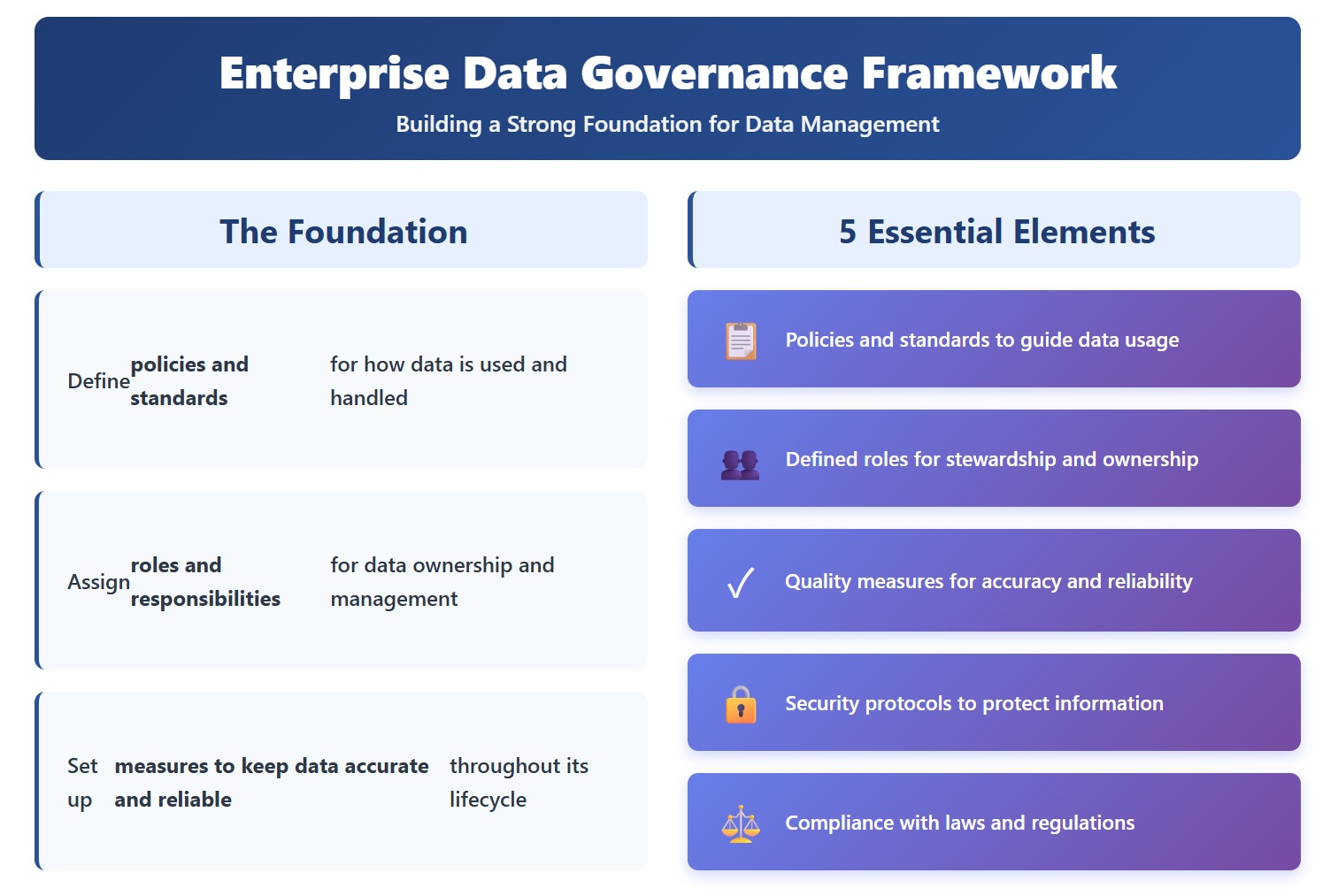 Enterprise Data Governance Framework
Why Enterprise Data Governance matters
A mature Enterprise Data Governance program helps organizations:
- reduce regulatory and audit risk
- improve data quality and consistency
- support trusted analytics and AI
- create clear ownership and accountability
- accelerate decision-making across functions
When governance is absent, business teams often create their own definitions, workarounds, and shadow processes. That leads to fragmented reporting, slow approvals, and costly rework.
How governance differs from data management, security, and privacy
These disciplines overlap, but they are not the same.
| Discipline | Primary Focus | Typical Question |
|---|---|---|
| Enterprise Data Governance | Decision rights, policies, accountability, standards | Who owns this data and what rules apply? |
| Data Management | Data integration, storage, pipelines, lifecycle execution | How is data collected, transformed, and delivered? |
| Data Security | Protection against unauthorized access and threats | How do we secure this data from misuse or attack? |
| Data Privacy | Lawful, ethical handling of personal data | Are we using personal data in a compliant way? |
A practical way to think about it: governance sets the rules, management executes them, security protects the environment, and privacy ensures lawful use of personal information.
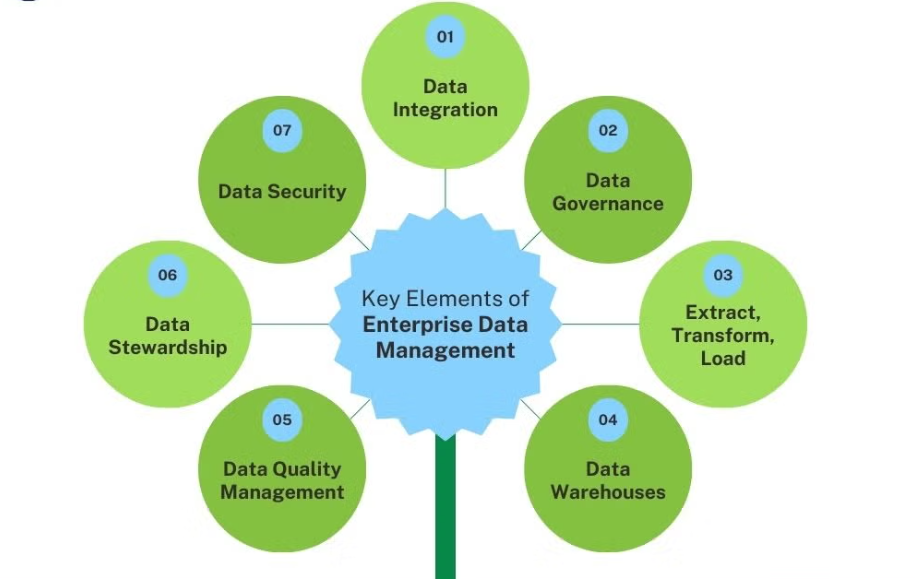
Core Benefits of an Enterprise Data Governance Program
An Enterprise Data Governance program should not be treated as a documentation exercise. Its purpose is to improve business performance and reduce organizational risk.
Improve data quality, consistency, and trust across teams
When definitions, standards, and ownership are clear, data becomes more reliable. Finance, sales, operations, and analytics teams can work from the same logic and the same trusted sources.
This improves:
- report consistency
- metric alignment
- self-service analytics adoption
- confidence in dashboards and models
Without governance, the same KPI may be calculated three different ways by three different departments.
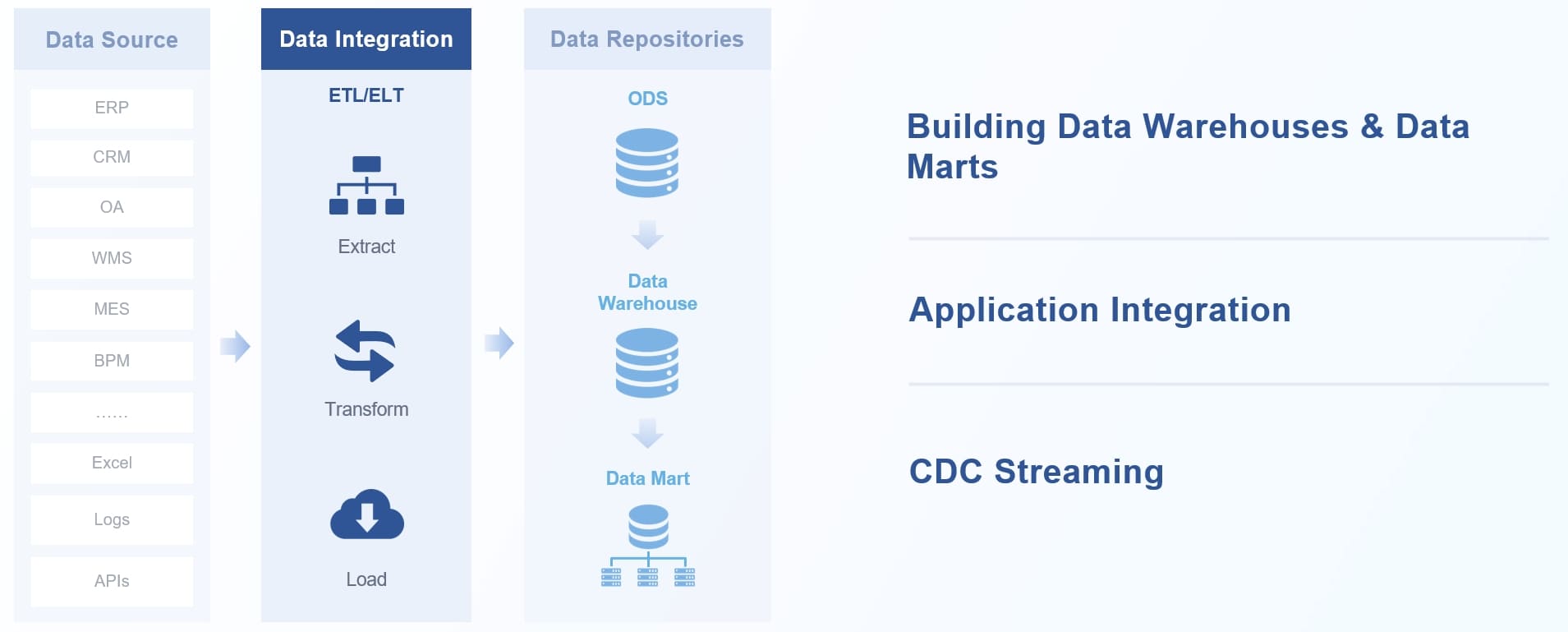
Reduce regulatory, operational, and reputational risk
Enterprises operate under growing pressure from regulators, customers, auditors, and internal control functions. Governance creates a formal structure for classification, retention, access control, escalation, and evidence collection.
This lowers the chance of:
- unauthorized data exposure
- policy violations
- failed audits
- retention breaches
- public trust damage after data mishandling
Support better reporting, AI initiatives, and business decisions
AI and advanced analytics depend on governed data. If metadata is missing, lineage is unclear, or quality issues are unresolved, model outputs become harder to trust and harder to explain.
Enterprise Data Governance creates the foundation for:
- standardized reporting
- high-confidence forecasting
- governed data sharing
- explainable AI inputs
- reusable enterprise data products
Create accountability for how data is created, shared, and used
Governance makes it explicit who is responsible for business rules, quality thresholds, access approvals, and remediation workflows. That accountability is what turns governance from theory into operational discipline.
Key Roles and Responsibilities of Enterprise Data Governance
Successful Enterprise Data Governance programs are built on clear decision rights. If ownership is vague, policies will be ignored and issues will sit unresolved.
Executive sponsors and governance council
Executive sponsors provide political backing, budget support, and cross-functional alignment. The governance council translates that support into decisions and priorities.
Their responsibilities typically include:
- approving governance strategy and policy direction
- prioritizing critical data domains
- resolving cross-department conflicts
- aligning governance with business goals
- tracking program progress at the executive level
In large enterprises, this group often includes leaders from data, IT, risk, compliance, finance, operations, and major business units.
Data owners, stewards, and custodians
These are the roles that make Enterprise Data Governance practical.
Data owners
Data owners are accountable for the business meaning and approved use of specific data domains. They usually sit in the business, not just IT.
Typical responsibilities:
- define business rules
- approve access and usage standards
- set quality expectations
- decide remediation priorities
Data stewards
Data stewards manage the day-to-day governance of data assets and standards. They bridge business definitions and operational execution.
Typical responsibilities:
- maintain metadata and definitions
- monitor quality issues
- coordinate remediation
- document standards and workflows
- support policy adoption
Data custodians
Custodians are typically technical teams responsible for storing, moving, protecting, and maintaining data environments.
Typical responsibilities:
- implement controls
- maintain systems and pipelines
- support retention and archival
- enforce technical access settings
- provide operational evidence for audits
IT, security, legal, and business teams
Enterprise Data Governance only works when these functions coordinate continuously.
- IT supports architecture, integration, metadata capture, and workflow enablement.
- Security enforces access controls, logging, monitoring, and control alignment.
- Legal and compliance define regulatory obligations, retention rules, and usage constraints.
- Business teams define what data means, how it should be used, and what quality is acceptable.
Policies, Standards, and Processes That Make Enterprise Data Governance Work
Governance becomes effective only when policies are operationalized. A shelfware policy set with no workflow, monitoring, or ownership will not survive enterprise scale.
Foundational policies to establish early
Start with a small set of policies that address the highest-risk and highest-value issues.
Recommended early policies include:
- Data classification policy: defines categories such as public, internal, confidential, and restricted.
- Access control policy: defines who can request, approve, grant, review, and revoke access.
- Data retention policy: defines how long data must be kept and when it should be archived or deleted.
- Acceptable data usage policy: defines permissible use of sensitive, regulated, or shared data.
- Issue escalation policy: defines how quality, access, compliance, or lineage issues are reported and resolved.
These policies should be short, practical, and tied to workflows people can actually follow.
Operational processes to keep governance practical
The best Enterprise Data Governance programs embed controls into daily operations rather than relying on manual policing.
Critical operational processes include:
- Metadata management: maintain business definitions, technical metadata, and ownership information.
- Data quality monitoring: track completeness, validity, consistency, timeliness, and uniqueness.
- Data lineage tracking: document where data came from, how it changed, and where it is used.
- Change control: manage schema updates, definition changes, source replacement, and downstream impact reviews.
- Access review workflows: periodically verify that users still need approved access.
- Issue management: route, prioritize, remediate, and close governance-related incidents.
Metrics that show progress
Executives need evidence that Enterprise Data Governance is improving business outcomes, not just generating meetings and policy documents.
Key Metrics (KPIs)
- Policy compliance rate: percentage of governed assets or processes meeting required policy controls.
- Data quality score: composite indicator of accuracy, completeness, consistency, validity, and timeliness.
- Critical data element coverage: proportion of high-priority data elements with assigned ownership, definitions, and controls.
- Issue resolution time: average time required to investigate and close governance or quality incidents.
- Access review completion rate: percentage of scheduled access reviews completed on time.
- Metadata completeness: percentage of cataloged assets with required business and technical metadata populated.
- Lineage visibility rate: share of key reports, pipelines, or datasets with documented upstream and downstream lineage.
- Stewardship adoption rate: percentage of target domains actively maintained by assigned stewards.
- Audit finding reduction: decrease in repeat audit issues related to data handling, access, retention, or reporting controls.
- Trusted report usage: adoption rate of certified dashboards, datasets, or semantic models across business teams.
A mature program should track a mix of control metrics, operational metrics, and business adoption metrics.
How to Set Up Enterprise Data Governance the Right Way
The fastest way to fail is to launch Enterprise Data Governance as a massive, abstract transformation program with no business anchor. Start with a specific problem, a limited scope, and measurable outcomes.
Start with scope, priorities, and critical data domains
Begin with the datasets that matter most to the business. In most enterprises, that means domains tied to revenue, customers, products, suppliers, finance, or regulated data.
Prioritization criteria should include:
- business impact
- regulatory exposure
- reporting importance
- data quality pain level
- cross-functional usage
- readiness of stakeholders
A good starting point is one or two high-value use cases, such as trusted executive reporting, customer master consistency, or governed data for AI model training.
Build a phased rollout plan
A phased rollout creates momentum and avoids governance fatigue.
Phase 1: Pilot
Select one domain, one sponsor, one steward structure, and a manageable policy set. Define success upfront.
Phase 2: Operationalize
Implement workflows for metadata, issue management, access approvals, and quality tracking. Connect governance to real systems and reporting.
Phase 3: Expand
Extend to additional domains, formalize council cadence, and standardize templates, controls, and scorecards.
Phase 4: Scale
Automate classification, lineage capture, policy checks, and exception handling where possible.
Common challenges and how to avoid them
Overengineering
Many teams try to document everything before governing anything. Avoid this by focusing on the minimum viable controls for the highest-value data.
Unclear ownership
If multiple teams assume someone else owns a dataset, governance stalls. Assign one accountable owner per domain and make responsibilities visible.
Poor stakeholder adoption
Governance fails when it feels like overhead. Tie policies to business outcomes teams care about: fewer report disputes, faster onboarding, cleaner audits, and more reliable AI outputs.
Tool-first thinking
A platform helps, but technology cannot compensate for weak ownership or vague standards. Design operating rules first, then enable them with software.
Actionable Best Practices for Implementing Enterprise Data Governance
Below is the consultant-style approach that works best in enterprise environments.
1. Define one business-critical use case before building the full framework
Choose a practical scenario such as board reporting consistency, customer record standardization, or regulated data access control. This creates urgency and makes ROI easier to demonstrate.
2. Assign named owners for every critical data domain
Do not settle for shared accountability. Each high-priority domain needs a business owner, a steward, and a technical custodian with documented responsibilities.
3. Standardize definitions and workflows before expanding tooling
Create approval-ready templates for:
- business glossary terms
- data quality rules
- access requests
- issue escalation
- exception handling
- change impact review
This reduces ambiguity and speeds rollout across domains.
4. Monitor KPIs monthly and escalate unresolved issues quickly
Governance programs lose credibility when issues remain open for months. Use scorecards and SLA-style targets for policy compliance, quality incidents, and remediation timelines.
5. Enable governed data movement and integration across systems
Governance often breaks down when data moves between platforms without consistent controls, lineage, or validation. This is where a modern integration layer becomes valuable. If your enterprise is connecting databases, SaaS tools, data warehouses, and analytics platforms, a tool such as FineDataLink can help operationalize trusted data delivery with more control over synchronization, integration efficiency, and downstream availability. That makes governance easier to enforce in real-world pipelines, not just in policy documents.
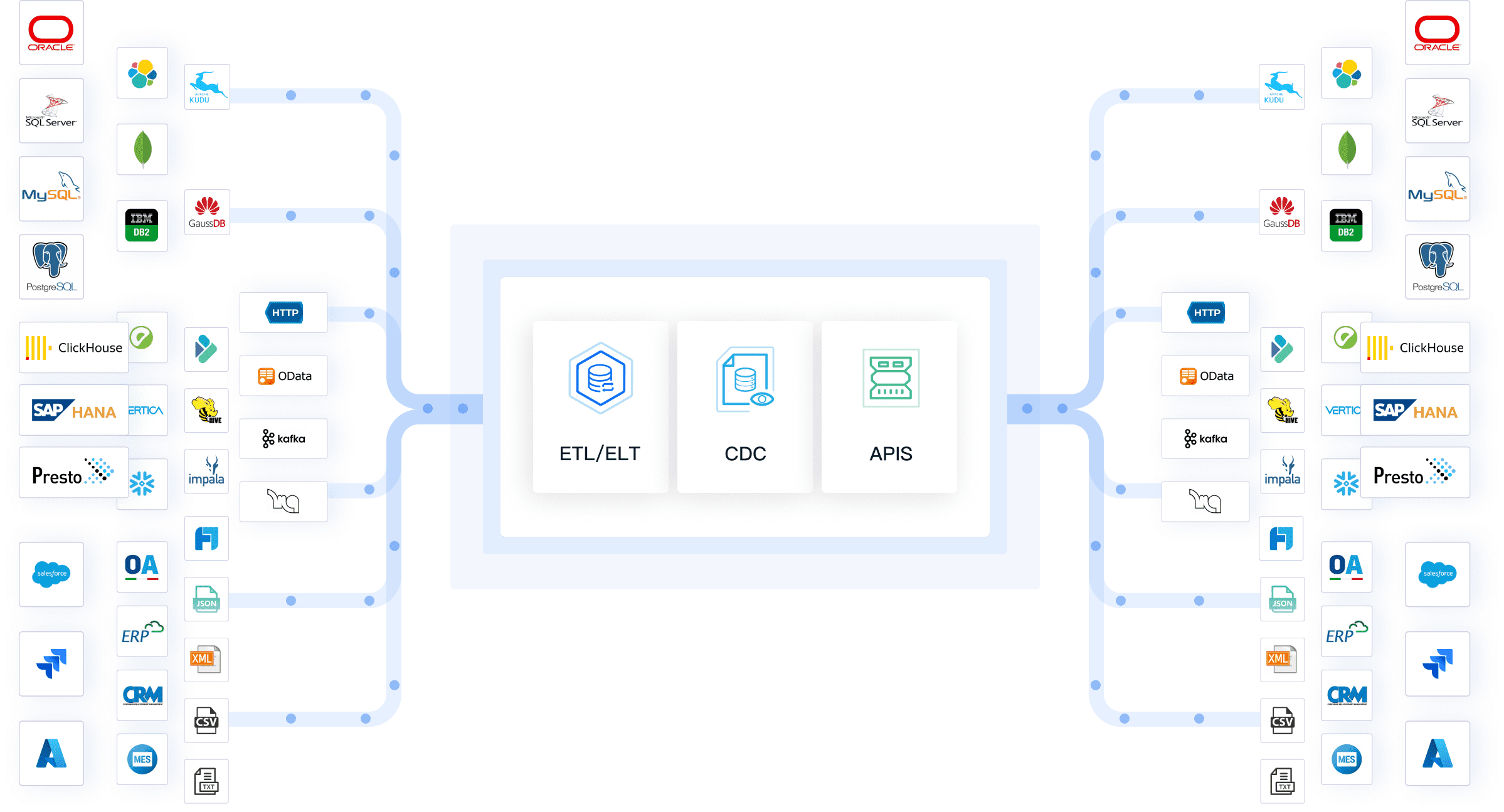 FineDataLink's Multi Source Data Integration
Choosing the Right Enterprise Data Governance Platform
The right platform should support your governance operating model, not dictate it. Enterprises typically need a combination of cataloging, workflow, metadata, lineage, quality monitoring, and policy reporting capabilities.
Must-have platform capabilities
At minimum, evaluate whether the platform can support:
- Data cataloging and discovery
- Business glossary management
- Ownership and stewardship assignment
- Technical and business lineage
- Policy workflow and approval routing
- Data quality rule monitoring
- Access governance integration
- Audit-ready reporting and evidence capture
- Scalable metadata ingestion
- Integration with cloud, on-premises, and hybrid environments
If your data landscape includes many operational systems and analytics targets, integration capability becomes especially important. A governance platform may define controls, but you also need reliable data connectivity and movement to maintain trust end to end.
How to evaluate vendors and ecosystem fit
Do not evaluate governance tools in isolation. Assess how well they fit your architecture, operating model, and user base.
Key evaluation questions include:
- Does the platform integrate with your existing data stack?
- Can it support your cloud, hybrid, and regional deployment requirements?
- Does it align with your access control and security model?
- Is lineage automated or mostly manual?
- Can business users actually navigate and maintain it?
- How quickly can stewards adopt workflows without heavy technical dependence?
- Does reporting provide executive-level governance visibility?
A vendor that looks strong in demos but weak in integration or usability will slow adoption fast.
Build versus buy considerations
Some enterprises consider building parts of their own governance framework using internal metadata stores, workflow tools, and dashboards. That can work in narrow cases, but the hidden operating cost is often underestimated.
| Option | Advantages | Trade-offs |
|---|---|---|
| Build | More customization, tighter control, tailored workflows | Higher implementation effort, slower time to value, ongoing maintenance burden |
| Buy | Faster deployment, mature features, vendor support, roadmap leverage | License cost, potential customization limits, dependency on vendor ecosystem |
For most enterprises, the smartest path is not pure build or pure buy. It is a fit-for-purpose stack: buy the core governance capabilities, integrate with existing security and data platforms, and use targeted custom workflows only where they create real competitive advantage.
Final Takeaway: Enterprise Data Governance Is an Operating Discipline, Not a Side Project
Enterprise Data Governance is not just about compliance and not just about data quality. It is the mechanism that lets a large organization trust its data at scale.
When done well, it gives leaders:
- clearer ownership
- cleaner audits
- more consistent reporting
- better analytics and AI readiness
- stronger control over how enterprise data is used
The most successful programs start small, focus on business-critical domains, assign clear accountability, and build operational workflows that teams can sustain. If your enterprise is also dealing with fragmented data movement across multiple systems, pairing governance with strong integration infrastructure can significantly improve execution. FineDataLink is a practical option to explore when you need governed, dependable data synchronization across complex environments.
FAQs
Enterprise data governance is the system of rules, ownership, and processes that defines how data is created, used, protected, and maintained across a business. Its goal is to make enterprise data consistent, trustworthy, and usable at scale.