
Financial institutions run on data. Customer records, transactions, risk models, product data, collateral details, claims, positions, and regulatory submissions all depend on information being accurate, consistent, secure, and traceable. That is exactly why data governance financial services programs have moved from “nice to have” to operational necessity.
For beginners, the term can sound abstract. In practice, it is not. Data governance is simply the set of decisions, rules, roles, and controls that help a bank, insurer, lender, or investment firm treat data as a managed business asset.
This guide explains what data governance means in financial services, why it matters, how the core framework works, and how to get started without overengineering the effort.
What Data Governance in Financial Services Means
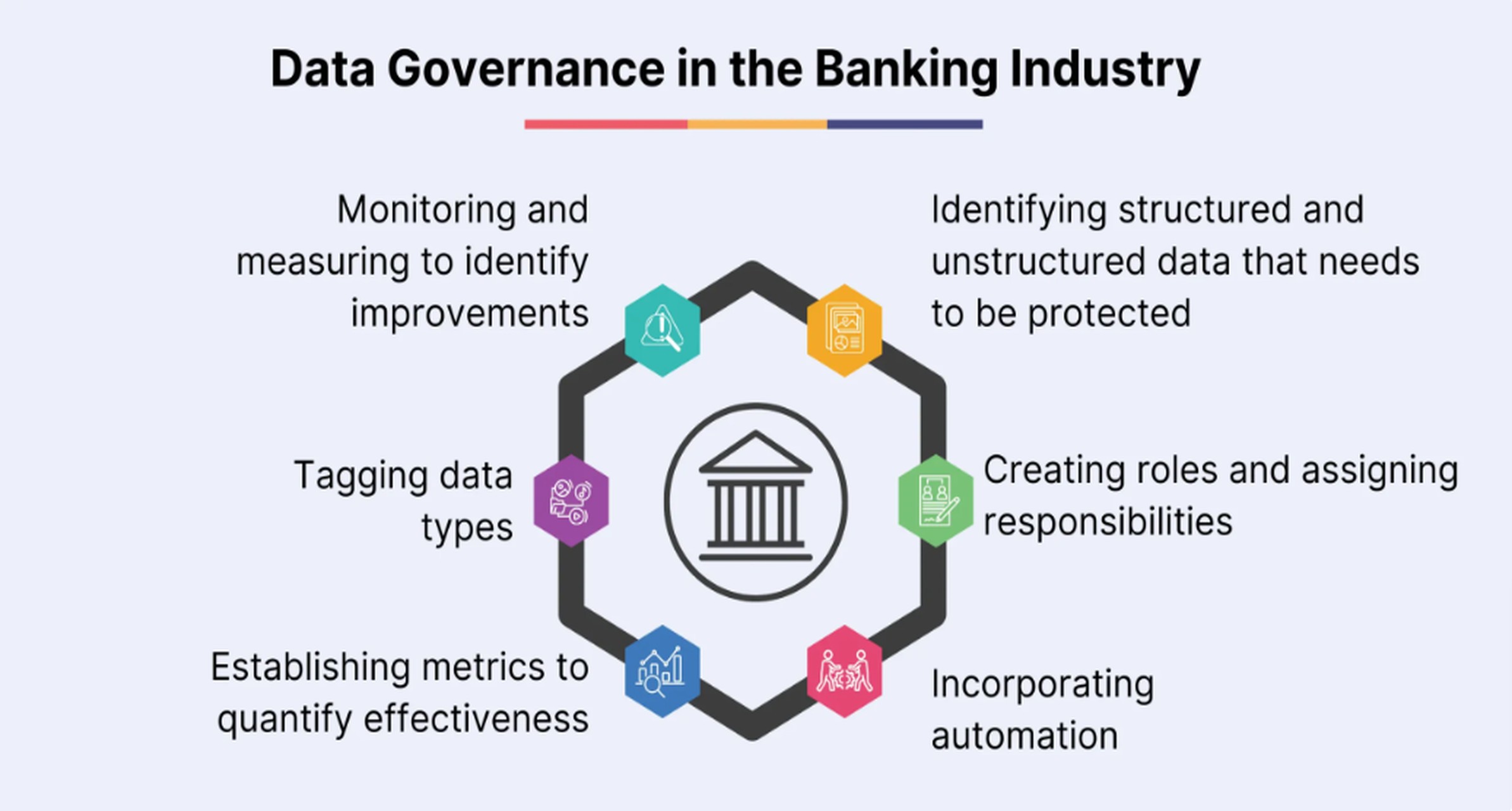
In financial services, data governance is the discipline of deciding:
- What key data means
- Who owns it
- Who can use it
- How quality is measured
- How issues are fixed
- How rules are enforced over time
For a bank, this may apply to customer identity, account status, exposure, default definitions, transaction records, and regulatory reporting fields. For an insurer, it may cover policyholder data, claims, underwriting attributes, and actuarial inputs. For lenders and investment firms, it often includes pricing data, risk metrics, portfolio attributes, and counterparty information.
Put simply, data governance financial services programs create order around critical data so the business can trust it.
Data governance is often confused with adjacent functions. They are related, but not the same.
| Discipline | Primary Focus | Typical Question |
|---|---|---|
| Data governance | Decision rights, rules, accountability | Who defines and approves this data? |
| Data management | Execution of data handling activities | How is the data stored, moved, and maintained? |
| Compliance | Meeting legal and regulatory obligations | Are we satisfying the rule or regulation? |
| Data security | Protecting confidentiality, integrity, access | Who should have access and how is it protected? |
| Analytics | Turning data into insight | What does the data tell us? |
A useful way to think about it: governance sets the rules, management executes them, compliance checks obligations, security protects access, and analytics uses the output.
This distinction matters because financial firms often assume they already have governance when they really have fragmented data operations, isolated controls, or reporting committees without clear ownership.
Highly regulated financial data needs more than storage and reporting. It needs:
- Clear ownership so definitions do not drift across departments
- Common standards so metrics remain consistent across systems and reports
- Controls so sensitive data is used properly
- Traceability so teams can explain where data came from and how it changed
- Escalation paths so quality issues are resolved before they become audit or regulatory problems
When those elements are missing, every downstream process suffers: onboarding slows down, risk reports conflict, audit findings increase, and executive decisions become less reliable.
Why Data Governance Matters for Financial Services
Financial firms face a simple problem with complex consequences: they depend on data to make high-stakes decisions, yet that data is often scattered across legacy systems, manual spreadsheets, vendor feeds, and business silos.
That is why data governance matters. It helps institutions reduce risk while improving day-to-day performance.
Risk reduction and regulatory readiness
In financial services, poor data quality is not just inconvenient. It can lead to:
- Incorrect regulatory reports
- Faulty credit or risk assessments
- Incomplete KYC records
- Delayed investigations
- Weak audit trails
- Customer complaints
- Fines, remediation costs, and reputational damage
Strong governance improves regulatory readiness by ensuring that critical data elements are defined, controlled, and monitored. When regulators, auditors, or internal control teams ask how a number was produced, the organization can answer with confidence.
Customer trust
Customers expect financial institutions to handle their information carefully and accurately. When addresses are wrong, customer risk ratings conflict across systems, or service teams cannot see the same profile, trust erodes quickly.
Governance supports trust by improving consistency across customer-facing processes such as onboarding, servicing, lending, claims, and digital interactions.
Better decision-making
Executives, risk leaders, finance teams, and frontline managers all rely on reports and dashboards. But reporting is only as strong as the underlying data definitions and controls.
Without governance, one department’s “active customer” may not match another’s. One report may define delinquency differently from another. These inconsistencies create debate instead of action.
With governance, decision-makers spend less time arguing over the numbers and more time responding to what the numbers mean.
Common pain points in financial institutions
Most beginners recognize data governance is needed when they see symptoms like these:
- Siloed systems that store different versions of the same customer or product
- Inconsistent reporting across finance, risk, compliance, and operations
- Poor data quality, including duplicates, missing fields, and outdated values
- Manual reconciliations that absorb time each month or quarter
- Unclear accountability for fixing data issues
- Access permissions that are too broad or poorly documented
- Weak data lineage for key reports and models
These are not only technical issues. They are governance issues because they reflect missing standards, unclear ownership, and weak operating discipline.
The business value of a stronger finance data strategy
A mature governance model does more than support compliance. It also creates business value through:
- Faster reporting cycles
- More reliable forecasting and planning
- Better risk monitoring
- Stronger cross-functional alignment
- Lower operational rework
- Improved model confidence
- Better use of analytics and BI tools
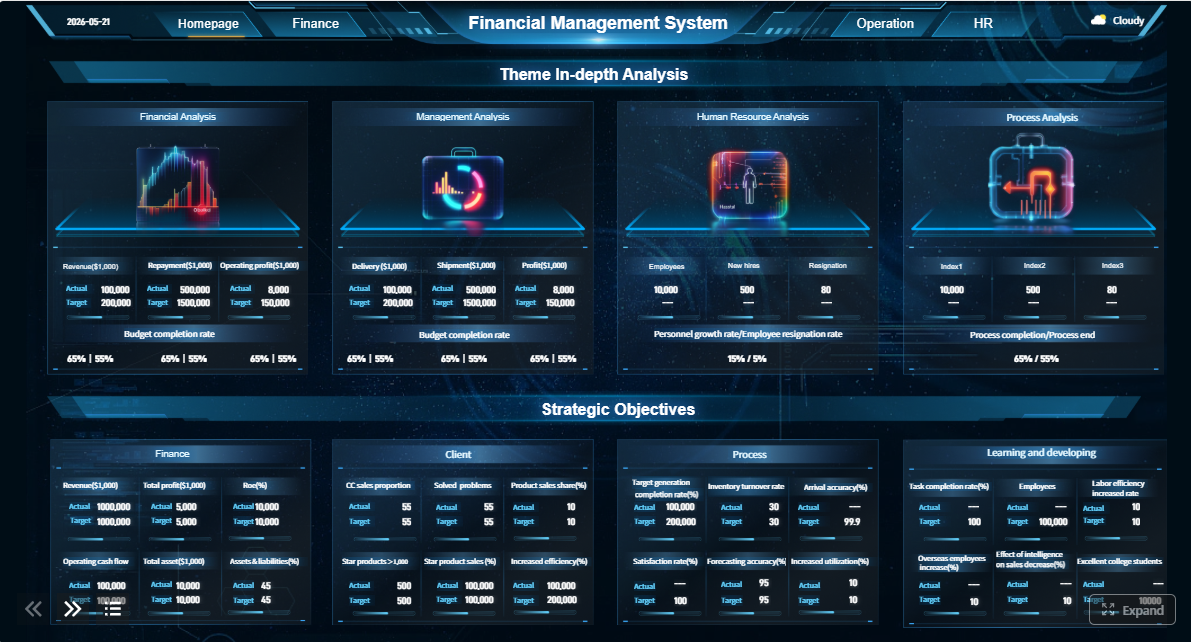
This is where platforms such as FineBI can become useful. Once governance establishes trusted definitions, ownership, and quality expectations, BI tools can expose consistent metrics to business users in a controlled and self-service way. Governance makes insight trustworthy; BI makes it usable.
Core Frameworks for Building a Data Governance Financial Services Program
A practical data governance financial services framework does not need to start large. But it does need to cover four essentials: policies, roles, processes, and oversight.
Policies, standards, and controls
Policies and standards are the written foundation of governance. They explain how data should be defined, handled, protected, retained, and reviewed.
At minimum, beginners should understand these document types:
| Document Type | Purpose | Example in Financial Services |
|---|---|---|
| Data governance policy | Sets overall principles and scope | Defines which data domains are governed and how decisions are made |
| Data standards | Standardizes definitions and formats | Common definition for customer status, exposure, or claim type |
| Data quality rules | Defines acceptable quality thresholds | Completeness of KYC fields must exceed a target percentage |
| Access control standard | Sets rules for permissions and reviews | Role-based access to customer PII and sensitive risk data |
| Retention policy | Defines how long data is kept | Transaction or claims records retained per legal and operational needs |
| Issue management procedure | Explains how defects are logged and resolved | Escalation path for broken regulatory reporting logic |
These documents do not need to be long. In fact, short and usable is often better than detailed and ignored.
A strong beginner approach is to focus first on:
- Critical data elements
- High-risk regulatory data
- Sensitive personal or financial information
- Data used in board, regulator, or model reporting
The goal is not to document everything at once. The goal is to create simple standards people can follow.
Roles and responsibilities
Governance fails when everyone believes data is important but no one is accountable. Clear roles are essential.
Below is a practical view of typical responsibilities.
| Role | Main Responsibility |
|---|---|
| Executive sponsor | Provides funding, authority, and cross-functional support |
| Chief Data Officer or equivalent | Leads enterprise data governance direction |
| Data owner | Accountable for the business definition, quality, and use of a data domain |
| Data steward | Manages day-to-day governance tasks, standards, and issue coordination |
| Compliance and risk teams | Align governance with regulatory and control expectations |
| IT and architecture teams | Support metadata, lineage, integration, access, and technical controls |
| Business users | Follow policies, raise issues, and use governed data correctly |
For beginners, the most important distinction is this:
- Data owners are accountable
- Data stewards are operationally responsible
- IT enables but does not own business meaning
- Compliance advises and challenges, but should not be the only governance driver
A common mistake is assigning everything to IT. In financial services, business ownership is critical because product, risk, finance, operations, and compliance teams understand the meaning and consequences of the data.
Processes and operating model
Policies and roles matter only if they are supported by repeatable processes. A workable governance operating model usually includes the following processes:
Issue management
When a data defect appears, the organization should know:
- How the issue is logged
- Who triages it
- How severity is determined
- Who approves remediation
- When escalation is required
- How closure is verified
This avoids the common problem of data issues being discussed repeatedly with no owner and no resolution date.
Data quality workflows
Data quality should be monitored through defined checks such as:
- Completeness
- Accuracy
- Validity
- Timeliness
- Consistency
- Uniqueness
A mature process does not just identify bad data. It also traces root cause and prevents recurrence.
Access reviews
Financial data access must be reviewed regularly, especially for:
- Customer personal data
- Payment and account information
- Credit and underwriting data
- AML investigation records
- Trading or portfolio data
- Regulatory reporting datasets
Governance helps connect access reviews to business ownership, rather than leaving them as isolated IT tasks.
Lineage tracking
Lineage shows how data moves from source to report, dashboard, or model. In financial services, lineage is especially important for:
- Regulatory reports
- Finance close and management reporting
- Risk aggregation
- Stress testing
- AML monitoring
- Credit models
Without lineage, teams struggle to explain transformations, reconcile changes, or defend calculations during audit.
Escalation paths
Not all data issues are equal. A missing optional field in a low-risk process is not the same as a broken feed affecting capital or suspicious activity monitoring. Governance should define escalation thresholds by impact, risk, and urgency.
Metrics and oversight
What gets measured gets managed. Governance programs need a small set of clear indicators.
Useful beginner metrics include:
- Percentage of critical data elements with assigned owners
- Percentage of approved definitions published
- Data quality scores by domain
- Number of open issues and aging trends
- Remediation time by severity
- Policy adoption by business unit
- Number of access reviews completed on time
- Lineage coverage for critical reports
- Audit findings related to data controls
These metrics should be reviewed by a governance forum or steering committee with enough authority to unblock decisions.
Good oversight is not about creating more meetings. It is about making accountability visible.
How Data Governance Works in Financial Services: Use Cases
The easiest way to understand governance is to see it in business use cases.
Customer onboarding
Customer onboarding depends on accurate and consistent identity, contact, risk, and product eligibility data. Governance helps by:
- Standardizing required fields and validation rules
- Defining ownership for customer master data
- Setting quality checks for missing or conflicting records
- Clarifying retention and consent rules
- Supporting auditability of onboarding decisions
When governance is weak, onboarding delays rise, duplicate profiles multiply, and downstream servicing becomes harder.
KYC and AML monitoring
KYC and AML processes rely on consistent customer, transaction, beneficial ownership, and alert data. Governance supports these processes through:
- Common definitions across business lines
- Controls on source system mapping
- Quality rules for mandatory compliance attributes
- Lineage for suspicious activity and case management data
- Clear ownership for remediation
This is a strong starting point for beginners because the regulatory importance is obvious and the business case is easy to explain.
Credit risk
In lending environments, governance improves confidence in inputs such as:
- Borrower identity and exposure
- Collateral values
- Default status
- Delinquency measures
- Internal and external credit attributes
If different teams use different definitions of exposure, default, or performing status, risk reporting becomes unreliable. Governance establishes common standards so portfolio, finance, and risk teams work from the same view.
Regulatory reporting
Regulatory reporting is one of the clearest proofs of governance maturity. It requires:
- Defined data elements
- Traceable transformations
- Documented controls
- Version management
- Evidence of review and signoff
A governed operating model reduces last-minute reconciliation and strengthens confidence during internal and external review.
Enterprise consistency across products and channels
Financial institutions often grow through mergers, new products, and channel expansion. That creates inconsistent definitions across retail, corporate, digital, and branch operations.
Governance creates a common language across business units. For example, it helps align:
- Customer
- Account
- Exposure
- Revenue
- Product hierarchy
- Region
- Delinquency
- Loss event
This consistency is essential for enterprise reporting and board-level decision-making.
Impact on auditability, models, and reporting
Governance improves three areas that matter to executives:
- Auditability: Teams can explain who owns data, how it changed, and what controls were applied.
- Model inputs: Risk and pricing models receive more consistent and documented inputs.
- Enterprise reporting: KPI definitions become stable, comparable, and easier to trust.
This is also where modern analytics platforms can add value. If governed data definitions are embedded in dashboards and semantic layers, tools like FineBI can help business teams explore performance faster without creating conflicting versions of key metrics.
A Practical Step-by-Step Approach to Data Governance Financial Services for Beginners
Many firms delay governance because they assume they need a large program, expensive tooling, or a full enterprise redesign. They do not. The best beginner approach is targeted, business-led, and incremental.
Assess the current state
Start by understanding the current environment. Focus on facts, not assumptions.
Review:
- Critical data domains such as customer, account, transaction, product, risk, and finance
- Major reporting and regulatory dependencies
- Known data quality issues
- Existing policies and standards
- Current ownership model
- Manual workarounds and reconciliations
- Pain points raised by audit, compliance, finance, risk, and operations
A simple current-state assessment should answer:
- Which data matters most?
- Where are the highest risks?
- Who currently makes data decisions?
- What policies exist today?
- Where are the biggest gaps in control or accountability?
Do not try to assess every dataset. Prioritize what is critical to the business and regulators.
Start with a focused scope
One of the most common failures in data governance financial services initiatives is trying to govern everything at once.
Instead, choose a focused entry point such as:
- A high-value use case like KYC, AML, or regulatory reporting
- A business unit with clear executive support
- A specific data domain such as customer or product
- A regulatory priority where improvement is urgent
A narrow first scope helps the team show value quickly. It also reduces political friction and makes governance easier to explain.
Good first-phase selection criteria include:
- High business impact
- Visible pain today
- Manageable scope
- Available stakeholders
- Measurable outcomes
Assign ownership and publish policies
Once scope is defined, establish decision rights clearly.
At minimum, identify:
- Executive sponsor
- Data owner
- Data steward
- Supporting IT lead
- Compliance or risk advisor
Then publish a practical set of documents:
- Data definitions
- Quality rules
- Access rules
- Issue escalation path
- Review and approval steps
Keep the documentation simple and usable. If people cannot understand or locate it, they will ignore it.
A lightweight governance pack often works better than a complex framework in the early stages.
Improve over time
Governance maturity builds through repetition. After the first scope is working, create a roadmap for expansion.
Typical next steps include:
- Extending stewardship to new domains
- Improving metadata and business glossary coverage
- Automating quality monitoring
- Expanding lineage documentation
- Formalizing governance forums
- Training business and operations teams
- Integrating dashboards for monitoring and adoption
This is where reporting maturity becomes important. Leaders need visibility into quality trends, issue backlogs, ownership coverage, and policy compliance. BI environments can support that visibility well when fed by governed definitions and workflows.
A practical roadmap should usually cover four tracks:
| Track | Early Focus | Later Maturity |
|---|---|---|
| Organization | Sponsorship, owners, stewards | Formal councils, enterprise operating model |
| Policy | Core rules and definitions | Expanded standards and periodic review |
| Process | Issue logging, quality checks, approvals | Automated workflows and control integration |
| Technology | Basic catalog, reporting, lineage capture | Scaled metadata, monitoring, and self-service analytics |
Common Challenges of Data Governance Financial Services and What Success Looks Like
Data governance is straightforward in theory but difficult in practice because it changes behavior, accountability, and decision-making.
Common challenges
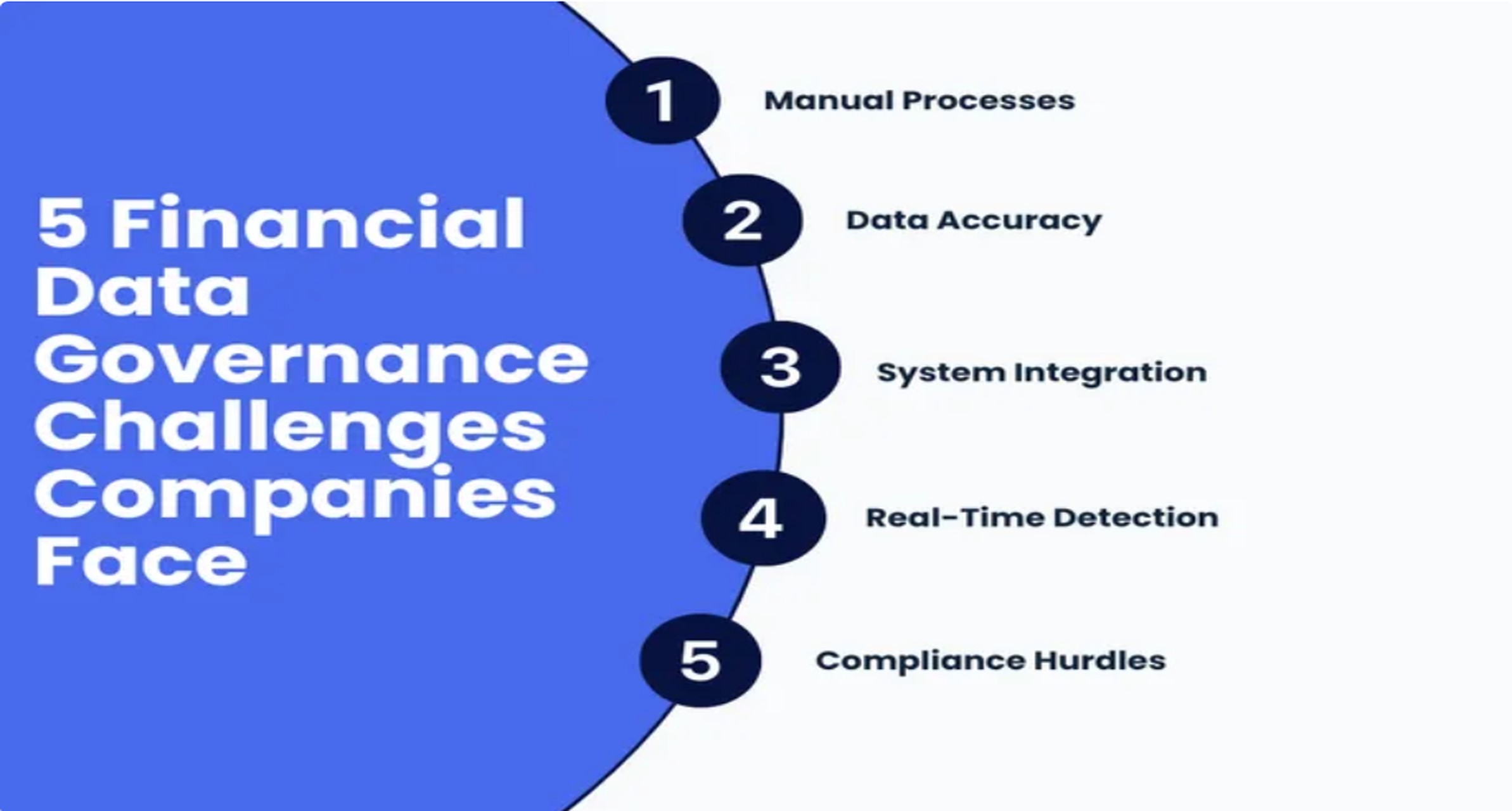
Resistance to change
Teams often see governance as bureaucracy. They worry it will slow delivery or add more approvals. The solution is to show how governance reduces rework, confusion, and regulatory risk rather than adding unnecessary overhead.
Fragmented technology
Financial institutions often operate across legacy platforms, acquired systems, spreadsheets, and vendor tools. Governance cannot remove this complexity overnight. But it can create common definitions and control points that make fragmentation more manageable.
Overlapping responsibilities
Risk, compliance, IT, finance, operations, and business teams all touch data. Without a clear model, responsibilities overlap or fall through gaps. Governance clarifies who decides, who executes, and who challenges.
Limited executive sponsorship
Governance without leadership support becomes a documentation exercise. The program needs executive backing because ownership conflicts, funding needs, and policy enforcement usually cross business lines.
Trying to solve everything with tools
Tools help, but tooling is not governance. A catalog, lineage platform, or dashboard cannot compensate for missing ownership or undefined standards. Technology should support the operating model, not replace it.
What success looks like
A successful data governance program in financial services usually has these traits:
- Critical data domains have named owners
- Key terms are defined and used consistently
- High-risk data quality issues are visible and tracked
- Reports and models are easier to explain and defend
- Access reviews happen on schedule
- Escalation paths are known and used
- Audit and regulatory conversations become more evidence-based
- Business teams trust shared metrics more than local spreadsheets
Success does not mean perfection. It means the institution can identify, govern, monitor, and improve the data that matters most.
A simple checklist to begin
Use this checklist to launch a smart and practical governance effort:
- Identify one high-value financial services use case to start with
- Define the critical data elements involved
- Assign an executive sponsor, data owner, and data steward
- Publish plain-language definitions for key terms
- Set a small number of quality rules and thresholds
- Create a simple issue logging and escalation process
- Review access permissions for sensitive data
- Document basic lineage for key reports or controls
- Track a few governance KPIs monthly
- Expand only after the first scope shows measurable value
Data governance in financial services is not just a compliance exercise. It is a business operating capability. When done well, it lowers risk, improves reporting, strengthens trust, and creates a more scalable foundation for analytics, automation, and growth.
For beginners, the smartest move is not to build a massive framework on day one. It is to start where the business pain is real, define ownership clearly, publish practical rules, and measure improvement. That is how a governance program earns credibility.
And once that trust foundation is in place, institutions are in a far stronger position to unlock value from reporting, dashboards, and self-service analytics across the enterprise.
FAQs
It is the set of rules, roles, and controls that helps financial institutions define, manage, protect, and trust their data. In practice, it clarifies what important data means, who owns it, who can use it, and how issues are fixed.