
Customer master data management is the discipline that turns fragmented customer records into a trusted foundation for enterprise decisions. In practice, that means unifying customer data across CRM, ERP, service, marketing, finance, and operational systems so teams stop arguing about which record is correct and start acting on the same version of the customer.
For enterprise leaders, this is not just a data architecture issue. It directly affects campaign accuracy, account planning, service responsiveness, collections, compliance, and executive reporting. It also affects how well AI can support the business. If customer identities, hierarchies, and attributes are inconsistent, dashboards become unreliable and AI outputs become harder to trust.
With FineBI + Dora, business users can ask for analysis in chat, generate chart-based answers or dashboard-style views from trusted BI assets, and receive scheduled summaries before the next meeting. That makes customer master data management more actionable: not just cleaner records in the background, but better Customer 360 analytics in daily use.
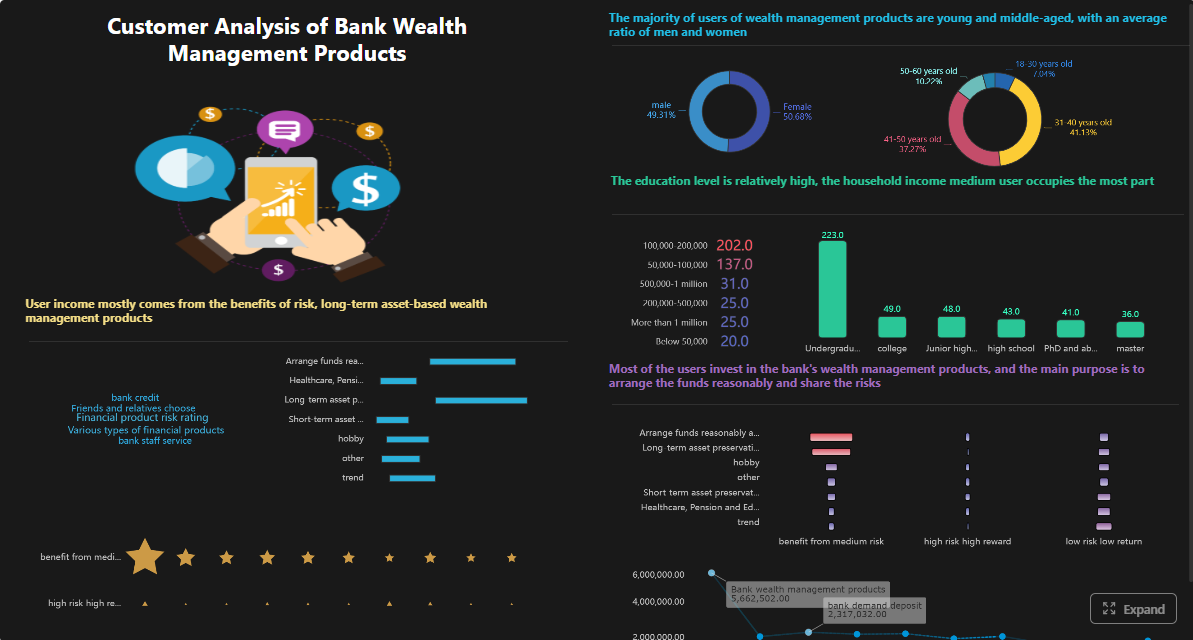 Click To Try The Dashboard
All dashboards in this article are built with FineBI
What customer master data management means in enterprise settings
In enterprise settings, customer master data management creates a shared customer data foundation that multiple functions can trust. Sales needs account and contact visibility. Service needs a complete service relationship view. Marketing needs clean segmentation and consent-aware outreach. Finance needs billing, tax, and credit alignment. Operations needs delivery and relationship accuracy. Without a mastered customer foundation, each team works from partial or conflicting records.
At its core, customer master data management standardizes the way customer entities are identified and described across systems.
A shared customer data foundation across teams
A mature customer data foundation typically includes:
- Customer identifiers
- Legal and trading names
- Contact information
- Billing and shipping details
- Parent-child account hierarchies
- Household or organizational relationships
- Region, segment, and channel attributes
- Risk, status, and lifecycle classifications
This foundation gives the enterprise a consistent answer to questions like:
- Who is this customer?
- Is this the same customer as the one in another system?
- How are subsidiaries, branches, and contacts related?
- Which team owns the relationship?
- Which profile should reporting and downstream systems use?
Standardizing identities, profiles, hierarchies, and relationships
Customer data rarely lives in one place. A single enterprise customer may appear in:
- CRM as an account and multiple contacts
- ERP as a sold-to and bill-to party
- E-commerce as several buyer profiles
- Service systems as support request owners
- Marketing platforms as leads or campaign members
- Finance systems as invoice and payment entities
Customer master data management helps standardize these records so they can be matched, linked, and governed. This is especially important in B2B environments where one customer relationship may involve multiple legal entities, regions, locations, and contacts.
Integration, governance, and stewardship are not the same thing
Many organizations use these terms interchangeably, but they solve different problems:
- Customer data integration moves and synchronizes data across systems.
- Data governance defines the rules, ownership, quality standards, and access policies.
- Ongoing stewardship manages exceptions, reviews potential matches, resolves issues, and maintains trust over time.
A successful program needs all three. Integration without governance spreads inconsistency faster. Governance without stewardship becomes policy on paper. Stewardship without shared analytics makes it hard to prove business value.
Why trusted customer data matters for Customer 360 analytics
Customer 360 analytics depends on one thing above all: a reliable customer record. If the underlying customer data is fragmented, every dashboard, scorecard, segmentation model, and AI-generated summary becomes less trustworthy.
How fragmented records create business problems
When customer records are split across systems, enterprises typically face:
- Inconsistent customer counts in reports
- Duplicate outreach from sales and marketing
- Incomplete account histories in service
- Poor visibility into revenue by parent account
- Confusion in ownership and territory management
- Compliance risks from inaccurate personal or consent data
- Low trust in executive dashboards
A common pattern is that different teams believe they have “the right” customer number, but each version reflects only one process or one system. Customer 360 fails when the enterprise cannot reliably connect those records.
Why trusted records improve analytics and execution
Trusted customer records support better outcomes across the organization:
-
Segmentation: cleaner targeting by industry, tier, geography, behavior, or account group
Business value: fewer wasted campaigns and more relevant engagement
AI use: Dora can retrieve validated segment metrics from FineBI and summarize which customer groups are underperforming or overperforming. -
Personalization: more accurate recommendations, outreach timing, and service interactions
Business value: stronger conversion, retention, and customer satisfaction
AI use: Dora can surface profile-based insights in chat and prepare briefing summaries before campaigns or account reviews. -
Service quality: complete relationship context for support and success teams
Business value: faster issue resolution and fewer handoff errors
AI use: Dora can retrieve service-related customer views from FineBI and push exception summaries for high-priority accounts. -
Compliance and governance: consistent identity and access handling
Business value: better auditability and lower regulatory risk
AI use: Dora can help users find governed KPI views and approved customer analytics without bypassing FineBI permissions. -
Executive reporting: one consistent lens on customer growth, concentration, churn risk, and regional performance
Business value: more credible planning and investment decisions
AI use: Dora can generate scheduled leadership briefings using trusted FineBI metrics and business definitions.
The role of the golden record
A golden record is the trusted version of a customer profile used across teams and systems. It does not mean every source system becomes identical. It means the organization has an authoritative, governed customer entity that downstream applications and analytics can use consistently.
The golden record usually includes:
- Persistent customer ID
- Approved identifying attributes
- Resolved duplicates
- Preferred values for key fields
- Mapped source lineage
- Relationship and hierarchy links
- Governance and audit history
For Customer 360 analytics, the golden record is the anchor that lets FineBI model trusted metrics and lets Dora answer business questions with more confidence and control.
How golden records are created and maintained
Golden records are not created by a one-time cleanup project. They require matching logic, business rules, data quality controls, stewardship workflows, and ongoing synchronization with the systems that create and consume customer data.
Matching, merging, and survivorship rules
The first step is identifying which records likely refer to the same customer.
How duplicate records are identified
Matching may rely on combinations of:
- Exact keys such as tax ID or customer number
- Standardized names and addresses
- Email, phone, and domain comparisons
- Legal entity or branch relationships
- Confidence scoring based on multiple attributes
- Business-specific rules for B2B or B2C scenarios
High-confidence matches may be merged automatically under approved rules. Medium-confidence matches often require human review. Low-confidence cases may remain separate until more evidence appears.
How merging and survivorship work
Once likely duplicates are identified, the organization needs survivorship rules to determine which values become trusted. Examples include:
- Use ERP legal name as the preferred registered entity name
- Use CRM owner field for relationship ownership
- Use the most recently validated service phone number
- Keep finance tax identifiers only from approved billing systems
- Preserve both local and global parent relationships where relevant
This matters because merging is not just removing duplicates. It is selecting the best available attribute values in a governed way.
Data quality, governance, and stewardship workflows
Even the best matching rules fail if data quality is inconsistent. Customer master data management depends on repeatable quality controls and clear business ownership.
Core data quality processes
Typical workflows include:
- Validation of required fields
- Address and contact standardization
- Format normalization
- Enrichment from approved sources
- Duplicate prevention at entry
- Exception handling for suspicious records
- Human review for ambiguous matches
Governance and stewardship responsibilities
A strong operating model clarifies:
- Which team owns customer identity standards
- Who approves rule changes
- Who reviews merge exceptions
- What quality thresholds trigger escalation
- Which domains are mandatory before publishing trusted records
- How regional or business-unit differences are handled
For enterprise adoption, stewardship cannot sit only with IT. Business data owners must help define what “trusted customer” means in real operations.
Integration with CRM, ERP, CDP, and analytics platforms
Customer master data only creates value when trusted records flow into the systems people actually use.
Operational and analytical integration
A practical architecture often connects trusted customer data with:
- CRM for account planning and pipeline visibility
- ERP for billing, order, and contract alignment
- CDP or marketing tools for audience activation
- Service platforms for support context
- Data warehouse or lakehouse for analytics
- BI tools for reporting and performance management
Why bidirectional synchronization and auditability matter
Enterprise teams should pay close attention to:
- Bidirectional synchronization: downstream systems may need both mastered updates and source feedback loops.
- Lineage: teams must know where values came from and how they changed.
- Auditability: stewards and auditors need traceability for merges, overrides, and rule decisions.
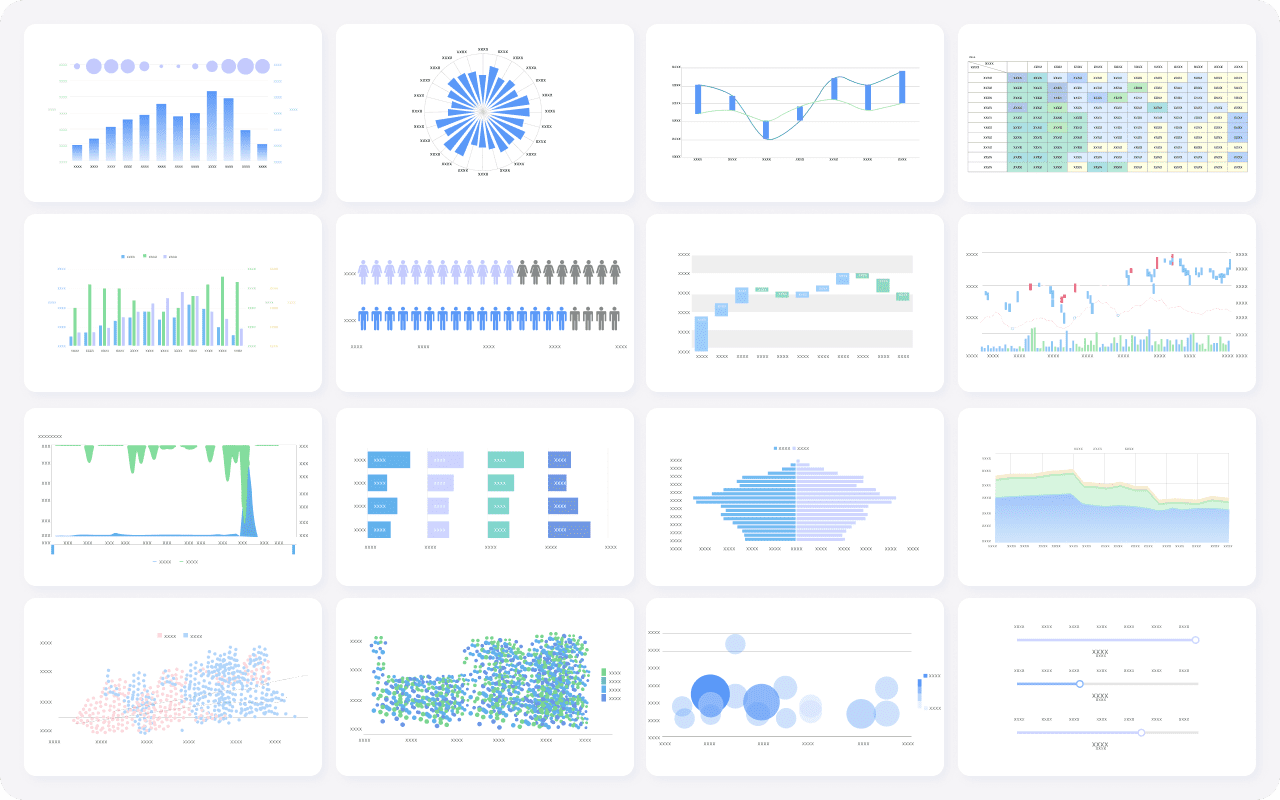
This is also where FineBI becomes highly practical. Once trusted customer entities and relationship fields are available in the analytical environment, FineBI can build governed dashboards, reusable metrics, and semantic assets for Customer 360 reporting. That turns mastered data into something the business can actually consume.
Common implementation models and solution considerations
There is no universal deployment model for customer master data management. Enterprises usually choose between building, buying, or extending based on data complexity, governance maturity, integration needs, and internal delivery capacity.
Build, buy, or extend an existing data platform
Each option has tradeoffs.
Packaged MDM tools
Packaged tools usually provide:
- Matching and merge logic
- Stewardship workflows
- Audit trails
- APIs and connectors
- Governance features
- Operational synchronization support
Best fit: enterprises that need faster time to value and proven governance depth.
Custom-built solutions
Custom solutions may use data pipelines, databases, matching libraries, and internally developed review workflows.
Best fit: organizations with highly specific needs, strong engineering capacity, and tolerance for longer implementation cycles.
Extensions to existing data platforms
Some teams extend current platforms such as warehouse-centric architectures, data quality tools, or application ecosystems.
Best fit: enterprises seeking tighter alignment with existing architecture and lower platform sprawl.
The real decision is not only technical. It is operational. Can the chosen model support ongoing stewardship, policy enforcement, and trusted analytics at scale?
Evaluation criteria for selecting a platform
When evaluating a platform or approach, enterprises should assess the following:
- Scalability: can it handle growing source systems, records, and regions?
- Matching accuracy: does it support flexible rules and confidence-based review?
- Workflow support: can stewards review, approve, reject, and document decisions?
- API availability: can trusted records flow into operational and analytical systems?
- Security: are access controls, auditing, and compliance requirements supported?
- Usability: can business stewards participate without heavy technical dependency?
- Vendor support and services: is there practical implementation guidance?
- Peer feedback: reviews, ratings, and customer references can reveal adoption realities beyond feature lists.
For analytics-driven organizations, another key question is: how quickly can mastered customer data become governed reporting assets? This is where a strong BI layer matters. FineBI helps teams operationalize trusted customer data into dashboards, KPI models, and reusable semantic definitions rather than leaving the value trapped inside data management workflows.
How an AI Data Agent Handles This Scenario
Customer master data management often fails to show value because business users still struggle to access the right insight at the right time. They may have trusted records in the backend, but frontline managers still wait for analysts, search across dashboards, or manually reconcile views before meetings.
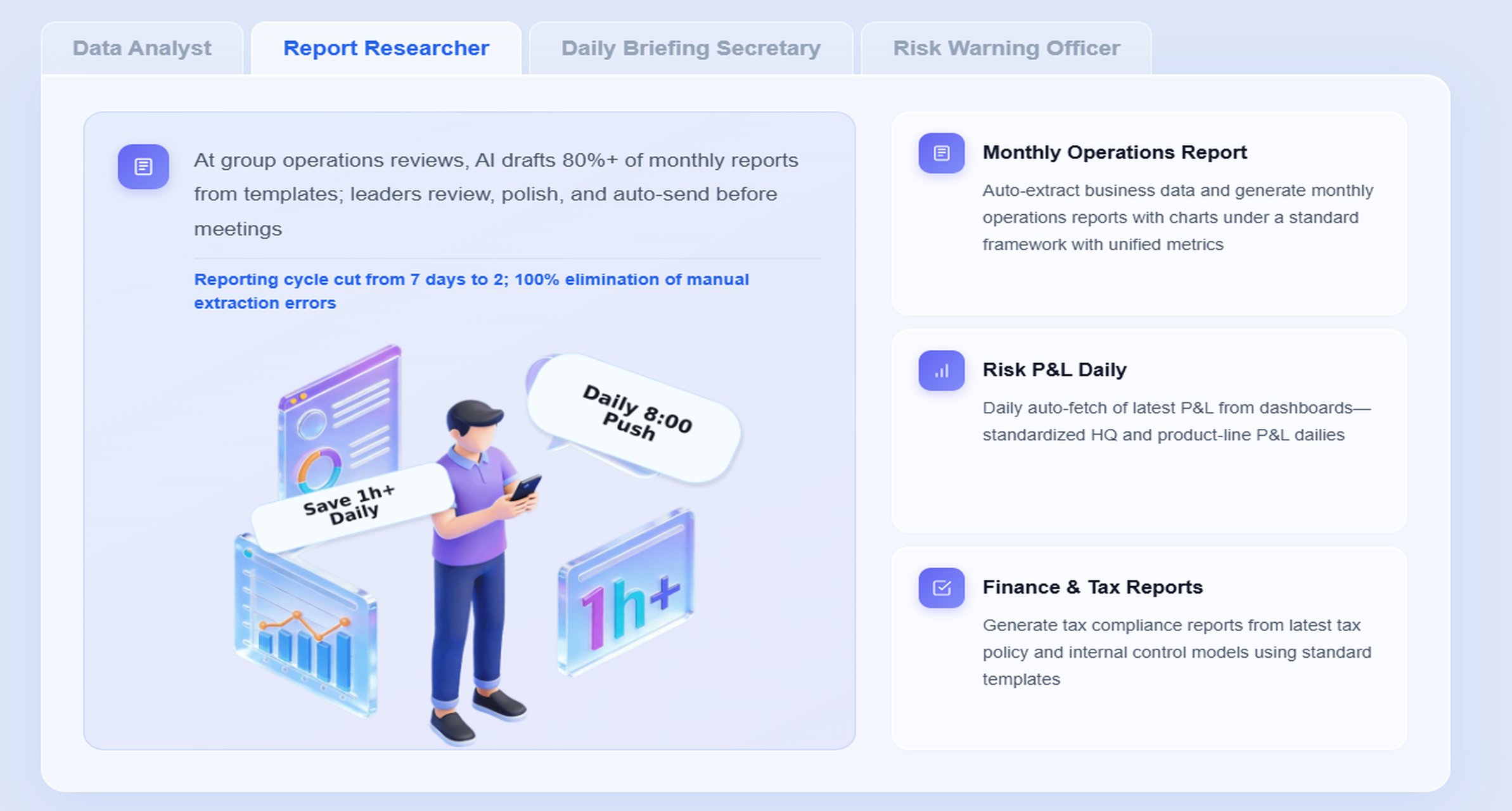
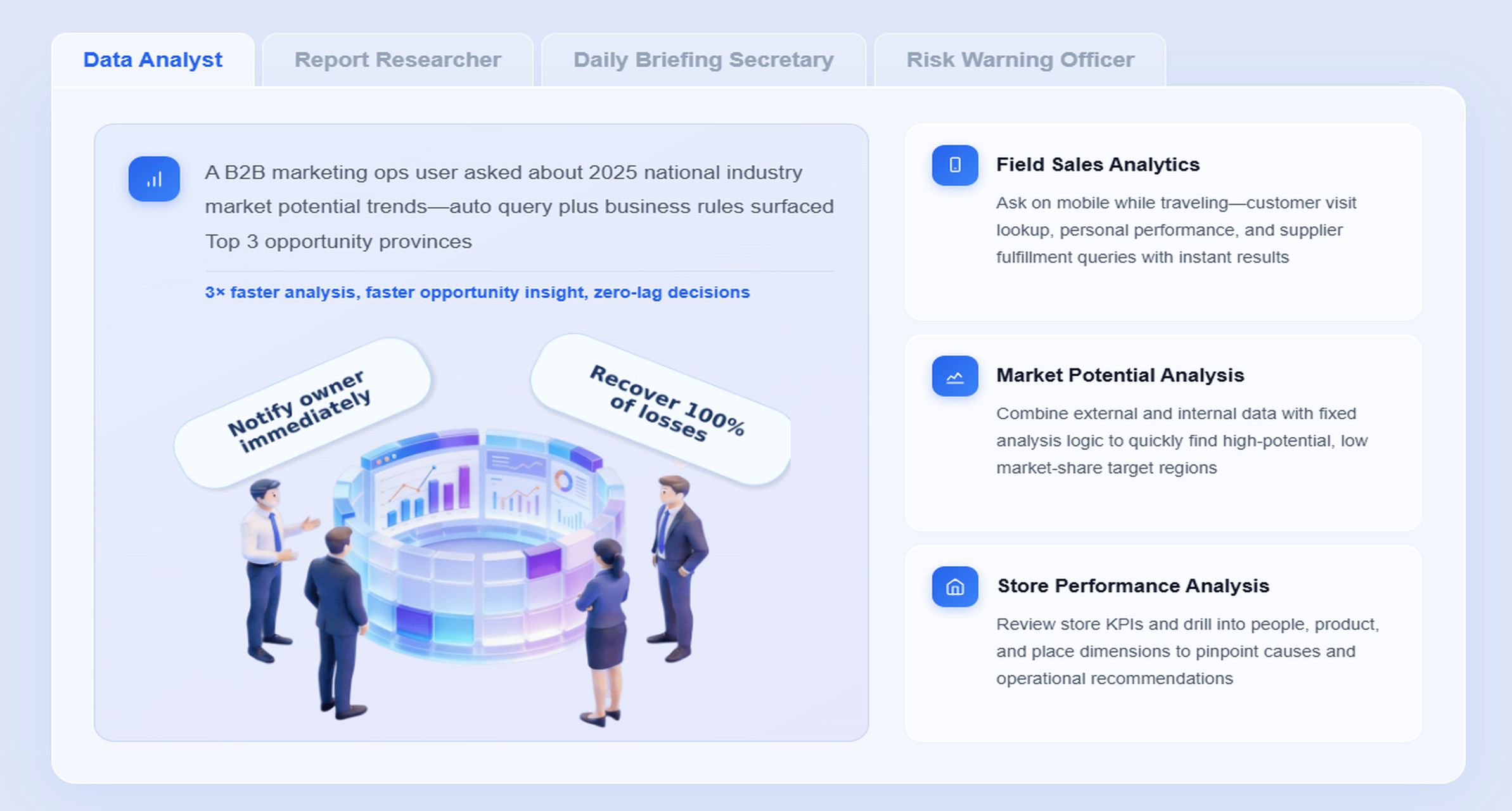
This is where Dora, FanRuan’s enterprise Data Agent platform, becomes practical. Dora sits on top of trusted BI assets and governed enterprise data. Instead of asking users to navigate every dashboard themselves, Dora helps them ask for Customer 360 analysis in natural language and receive chart-based answers, dashboard-style analysis views, summaries, alerts, and follow-up prompts.
The most relevant Dora digital employee for this scenario is the Data Analyst digital employee, supported by the Daily Briefing Secretary and Risk Alert Officer for recurring monitoring and exception management.
Example chat request:
“Show me duplicate customer trends, profile completeness by region, parent-account revenue concentration, and the top service-risk customers affected by fragmented records this month.”
How Dora works with FineBI in customer master data management
FineBI provides the trusted BI foundation:
- Governed customer KPIs
- Semantic definitions for customer entities and hierarchies
- Reusable dashboards for Customer 360 analytics
- Permission-controlled access to mastered customer views
- Drill-down analysis across region, segment, owner, and source system
Dora turns that foundation into an AI assistant for business execution:
- Natural-language data query over trusted BI assets
- Dashboard and metric retrieval from FineBI
- Chart-based answers and dashboard-style analysis views in chat
- Scheduled summaries for managers and executives
- Anomaly alerts when duplicate rates or data quality thresholds worsen
- Follow-up pushes to accountable owners
A practical 6-step AI workflow
- Retrieve trusted FineBI dashboards or subject-area data related to customer quality, golden record coverage, profile completeness, hierarchy mapping, and Customer 360 analytics.
- Understand KPI definitions and semantic rules such as what counts as a duplicate, how completeness is scored, and which hierarchy source is authoritative.
- Generate chart-based answers in chat showing trends, breakdowns, and risk lists by region, segment, business unit, or owner.
- Detect abnormal changes or threshold breaches such as duplicate spikes, declining completeness, or rising unmatched parent accounts.
- Push summaries or alerts to the right stewards, operations leads, account managers, or executives based on permissions and responsibility rules.
- Produce follow-up summaries for weekly governance meetings, executive reviews, or business-unit remediation planning.
Why this AI approach lands better in enterprises
Dora should not be treated as a generic chatbot. It is an enterprise Data Agent built for governed AI workflows. That matters because customer master data management requires controlled definitions, permissions, reviewability, and repeatable operating logic.
Compared with prompt-only agent experiments, Dora is designed for:
- More controllable Skills-based execution
- Better alignment with trusted semantic assets
- Reduced token waste from repeatedly reconstructing business context
- Faster response paths for recurring data work
- More stable enterprise workflows with permission boundaries and governed metrics
For executives, this means Dora is not an AI experiment. It is a landed AI digital employee for recurring customer data work such as weekly Customer 360 briefing, duplicate issue follow-up, service-risk visibility, and management review preparation.
For IT teams, the role shifts from manually answering every analytics request to improving semantic layers, quality controls, permissions, and reusable AI Skills.
For business users, the benefit is simple: faster access to trusted customer insights without searching through multiple dashboards or waiting in the analyst queue.
Best practices for successful customer master data management
Customer master data management succeeds when business outcomes, governance, and operating design move together. The goal is not just better records. It is better execution.
Start with business outcomes and high-value use cases
Begin with problems that stakeholders already feel:
- Duplicate customer outreach
- Inconsistent parent-account reporting
- Poor campaign targeting
- Incomplete service visibility
- Conflicting executive customer metrics
Focus on measurable outcomes such as reducing duplicates, improving profile completeness, or increasing consistency in Customer 360 reporting. Early wins create momentum for broader rollout.
Establish governance early and assign clear ownership
Governance should be designed from the start, not after integration work is finished. Define:
- Customer data domains
- Attribute ownership
- Stewardship roles
- Approval paths
- Quality thresholds
- Escalation rules
- Policy exceptions
Without this, golden records quickly degrade or become disputed.
Build a semantic layer inside the BI workflow
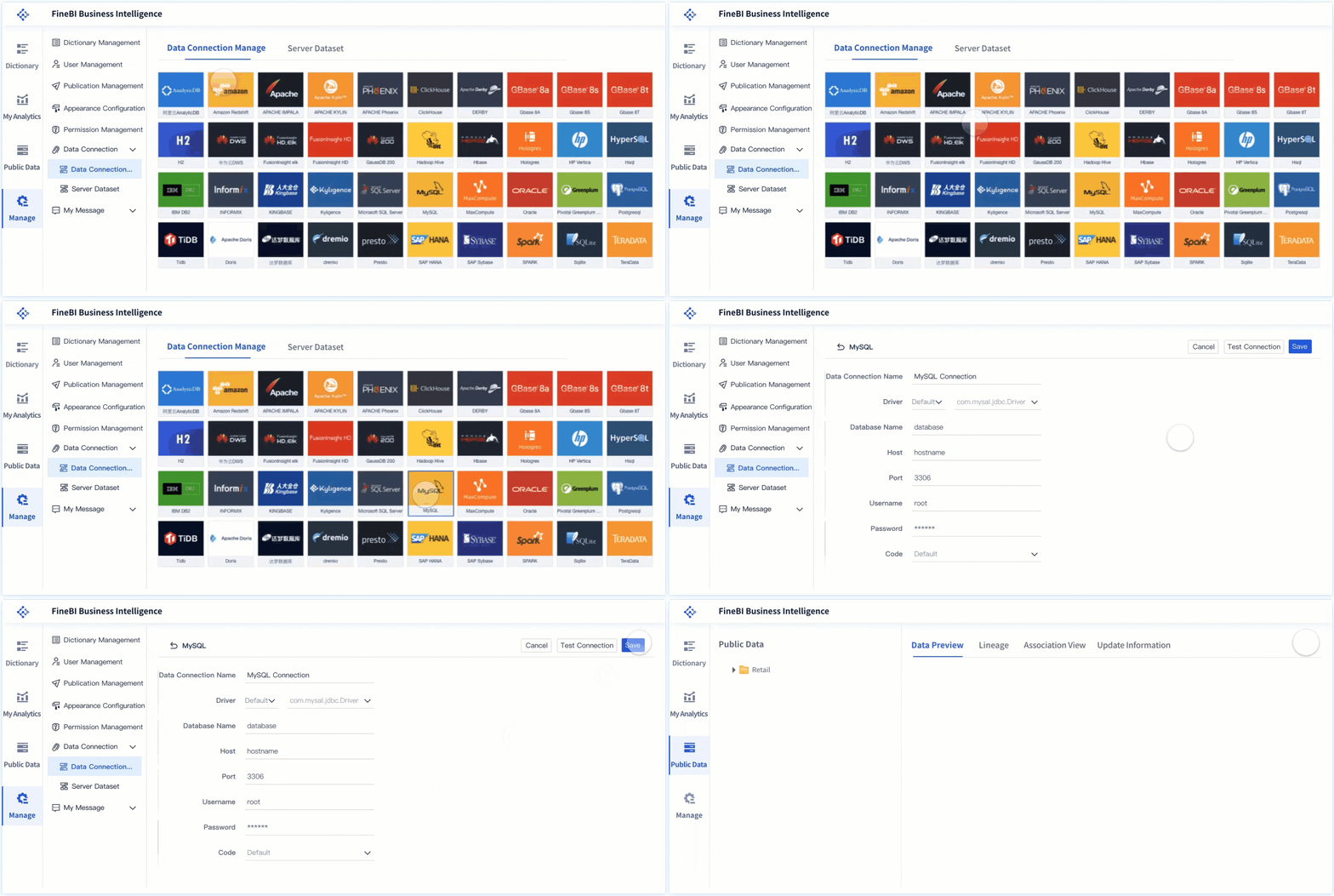
A common gap in MDM programs is that trusted records exist, but analytics definitions remain inconsistent. FineBI helps close that gap by turning mastered customer data into governed semantic assets, metrics, and dashboards.
That is also what makes Dora more useful. AI works better when KPI definitions, business synonyms, dimensions, and drill paths are standardized in the BI layer.
Start AI with repeatable workflows, not everything at once
This is one of the most important AI-specific best practices. Do not begin by asking an AI assistant to support every customer question in the business. Start with recurring, high-value workflows such as:
- Weekly customer quality briefing
- Duplicate trend reporting
- Regional completeness exception alerting
- Executive Customer 360 summaries
- Service-risk customer follow-up
This creates a practical path for Dora to deliver value through governed AI workflow design.
Preserve permissions, review, and escalation logic
Another critical AI-specific best practice is making sure AI outputs respect FineBI access boundaries and governance rules. Dora should retrieve only what the user is authorized to see, and high-impact workflows should include review steps where needed.
Use human review for AI-generated reports at the beginning, then expand Dora Skills gradually as trust and process maturity improve.
Design for incremental rollout and continuous improvement
A strong program usually expands in phases:
- Start with a focused region, unit, or channel
- Establish trusted golden record logic
- Publish core Customer 360 dashboards in FineBI
- Add Dora for chat-based analysis, scheduled summaries, and alerts
- Expand to more systems, markets, and stewardship scenarios
How to measure success and plan next steps
Customer master data management should be measured as both a data initiative and a business adoption initiative.
Core KPIs to track
Use a structured KPI set that ties quality improvements to business trust and usability.
-
Duplicate reduction rate: Percentage decrease in duplicate customer records over time.
Business value: Reduces wasted outreach, reporting inflation, and account confusion.
AI use: Dora can retrieve the metric in chat, compare current performance with prior periods, and include it in weekly data quality briefings. -
Profile completeness score: Percentage of customer profiles meeting required attribute thresholds.
Business value: Improves segmentation, service readiness, and executive visibility.
AI use: Dora can summarize low-completeness segments and push exception lists to data stewards. -
Match confidence distribution: Breakdown of automatic, review-required, and unresolved matches.
Business value: Helps assess mastering quality and operational workload.
AI use: Dora can generate chart-based answers showing where review bottlenecks are growing. -
Issue resolution time: Average time to resolve customer data exceptions or stewardship tasks.
Business value: Measures operating efficiency and governance responsiveness.
AI use: Dora can alert managers when unresolved exceptions exceed defined thresholds. -
Analytics consistency rate: Degree of alignment between major customer reports and governed KPI definitions.
Business value: Increases trust in Customer 360 dashboards and executive reporting.
AI use: Dora can retrieve approved FineBI views and reduce use of unofficial spreadsheet reporting.
Build an adoption roadmap
A practical roadmap should align four dimensions:
- Data: source integration, quality rules, golden record logic, hierarchy handling
- Process: stewardship workflow, exception review, ownership, escalation
- Technology: MDM capabilities, synchronization, FineBI analytics, Dora agent workflows
- Change management: role alignment, user training, operating cadence, executive sponsorship
Teams are usually ready to move from fragmented records to trusted Customer 360 analytics when they have:
- Clear business use cases
- Agreed customer definitions
- Identified source systems and ownership
- Governance and stewardship processes
- A trusted BI layer for reporting and metrics
- A realistic AI workflow plan for recurring insight delivery
FineBI + Dora Solution Pitch
Building this manually is complex. FineBI helps teams build trusted dashboards, metrics, and semantic assets. Dora turns those assets into an AI assistant that can answer questions in chat, generate dashboard-style analysis views, push scheduled summaries, monitor anomalies, and follow up with responsible owners.
For customer master data management, that combination is powerful. FineBI gives the enterprise a governed analytical layer for Customer 360 reporting: duplicate trends, profile completeness, hierarchy coverage, service visibility, and executive KPIs. Dora adds the enterprise Data Agent layer so business users can interact with those trusted assets in natural language and receive timely summaries without depending on manual report assembly.
FineBI + Dora is not only a BI upgrade; it is a practical fourth-generation Agentic BI path. FineBI provides governed metrics and visual analysis. Dora provides the AI assistant layer for scenario execution, with more controlled Skills, lower token waste, faster execution paths, and more stable workflows than prompt-only agents.
Get Ready-to-Use Dashboard Templates in Fine Gallery
The strongest Dora pitch is scenario + product + service: FineBI provides the trusted BI foundation, Dora provides the AI digital employee, and implementation service connects data, governance, semantic setup, Skills, and rollout.
If your enterprise is trying to move from fragmented customer records to trusted Customer 360 analytics, the next step is not just choosing a data platform. It is making sure trusted customer data becomes usable, governed, and actionable for the people who run the business every day.
FAQs
Customer master data management is the practice of creating a trusted, consistent customer record across systems like CRM, ERP, service, marketing, and finance. It helps the business work from one reliable view of each customer instead of conflicting records.